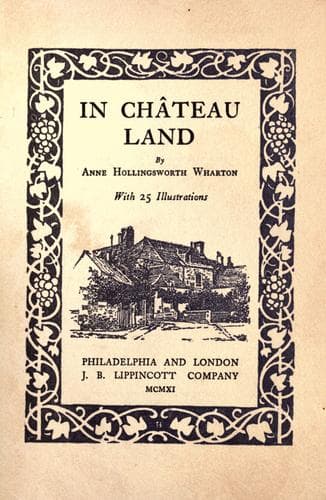
Castles -- France; Touraine (France) -- Description and travel
The most noticeable thing
about this building is its height, as houses of six stories were not
usual in the days of the Renaissance in France.
So little is done for Angers by local guide books that the joy of
discovery adds a zest to our pleasure in this old town, and, although
Archie is usually the least enthusiastic of sightseers, he has never
been bored once to-day. Perhaps Lydia's presence and delight in it all
has something to do with his contented frame of mind. However that may
be, he has listened with polite attention to M. La Tour's long
disquisitions, architectural as well as historical, and in return has
asked him many questions about the products and industries of this
prosperous town. It seems that the extensive slate quarries have not
only roofed and housed a great part of Angers, but have added
considerably to its revenue. Archie is in a merry mood to-day and after
M. La Tour's disquisition upon these extensive slate quarries, he asked
Lydia if she did not think that King Rene must have missed his slate
when he was scribbling verses in the south. We all laughed heartily over
this very slight _bon mot_; but our Frenchman looked dreadfully puzzled
and asked to have it explained to him. He proved even more difficult
than Sydney Smith's Scotchman; or, as Walter expresses it, "It had to be
driven in with a sledge hammer," and he warns Archie solemnly to attempt
no more pleasantries in the presence of our Gallo-American, guide,
philosopher and friend.
On our way back to the Cheval Blanc, we stopped at the Prefecture whose
superbly carved arches and columns are said to date back to the Roman
occupation. While we were enjoying these noble arches and rich carvings,
M. La Tour told us that Julius Caesar and one hundred thousand of his
troops were encamped upon the triangle upon a part of which Angers is
now situated. Here they lived for months on the resources of this
somewhat restricted area, which does not seem at all wonderful if the
soil was cultivated in those days as it is now; and how those soldiers
must have enjoyed the rich vintage of Anjou!--to say nothing of the
choux-fleurs, artichokes, peas, and the various fruits which are now
shipped in carloads to Paris every night.
The idea of a Roman camp in the neighborhood of Angers appealed strongly
to our antiquarians, and while we were at luncheon Archie, after
politely inquiring what we proposed to do with our long afternoon, and
finding that we had no plans except to visit some place of interest in
the motor car, presented a well arranged programme. What Archie
suggested, evidently after collusion with Walter and the chauffeur, was
to motor to Nantes, stopping _en route_ at the Roman camp, if indeed its
site can be found.
Public-domain text, read in full here on John Shaqi.
Reviews
Reviews
No reviews yet
Be the first to share your thoughts on this work.
Elsewhere in the archive
Join the Discussion
Join the discussion
Sign in to leave a comment or review.
Sign InorCreate an account