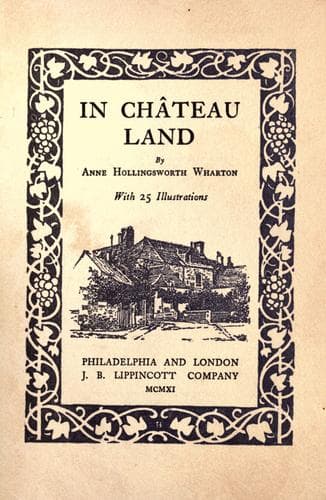
Castles -- France; Touraine (France) -- Description and travel
From the square, M. La Tour conducted us to the cathedral, which has
been criticized by Victor Hugo and many others, and which we, perhaps
from pure perversity, found much more harmonious than we had expected.
The facade, which the local guidebook pronounces majestic, even if
_batarde_ in style, is rich in decoration, and the little columns on
the towers I thought graceful and beautiful, however _batarde_ they may
be. Two cathedrals have stood upon the site of the present Sainte Croix,
the last having been destroyed by the Huguenots, to whom are attributed
the same sort of destruction that marked the course of Oliver Cromwell's
army in England. It is said that the great Protestant leader, Theodore
de Beze, himself blew up the four noble pillars that once supported the
belfry. However this may be, and Miss Cassandra says that we are all
free to believe such tales or not, as we choose, very little is left of
the old edifice except the eleven chapels and the side walls. Even if
Theodore de Beze destroyed the old cathedral, the building as it now
stands was the work of his former chief, for it was Henry of Navarre who
laid the corner stone of the new edifice, in 1601, to fulfill a vow made
to Pope Clement VIII who had absolved him from the ban of
excommunication.
In the side windows, in richly colored glass, is the story of the Maid
of Orleans, from the day when she heard the voices and a vision appeared
to her while she kept her father's sheep in the fields near Domremy,
to the hour when she and her troops gave thanks for the victory of
Orleans in this cathedral. On through the eventful months of her life to
the sad and shameful scenes at Rouen, where the innocent and devoted
Maid was burned at the stake, while France which she had delivered, and
Charles whom she had crowned, made no sign, the story is told in a
series of pictures. Even if of modern glass and workmanship, these
windows seemed to us most beautiful, especially those on the right-hand
side through which the light streamed red, yellow and blue from the
jewelled panes. The window representing the crowning of Charles VII at
Rheims is especially rich in color. Joan, with a rapt ecstatic
expression on her face, is here to see her King crowned and with her is
the banner that she loved even more than her mystic sword. Below are
inscribed her own simple words, "It has been with him in the suffering,
it is right that it should be with him in the glory." Ever
self-effacing, it was of her beloved banner that Joan was thinking,
never of herself.
Public-domain text, read in full here on John Shaqi.
Reviews
Reviews
No reviews yet
Be the first to share your thoughts on this work.
Elsewhere in the archive
Join the Discussion
Join the discussion
Sign in to leave a comment or review.
Sign InorCreate an account