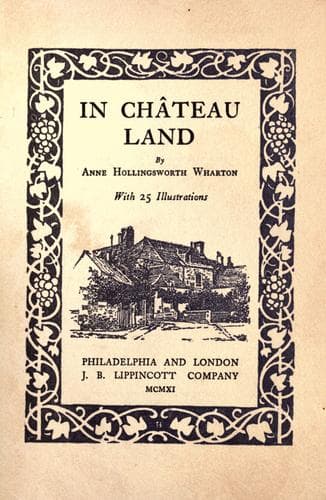
Castles -- France; Touraine (France) -- Description and travel
In a glass case are Madame de Stael's India shawls, which, like
Josephine de Beauharnais and other women of the period, she seems to
have possessed the art of wearing with grace and distinction. One of
these shawls appears in the familiar portrait by David, which is in a
small library or living room _au premier_; this we reached by climbing
many stairs. It is quite evident that David was not in sympathy with his
sitter, as in this painting he has softened no line of the heavy
featured face, and illumined with no light of intellect a countenance
that in conversation was so transformed that Madame de Stael's listeners
forgot for the moment that she was not beautiful.
Quite near the portrait of the exile of Coppet, as she was pleased to
call herself, is one of Baron de Stael Holstein, in court costume,
finished, elegant, handsome perhaps, but quite insignificant. It is
surely one of the ironies of fate that the Baron de Stael is only
remembered to-day as the husband of a woman whom he seems to have looked
upon as his social inferior. In this living room is a large portrait of
M. Necker, indeed, no room is without a portrait or bust of the idolized
father, and here, looking strangely modern among faces of the First
Empire, is a charming group of the four daughters of the Count
d'Haussonville, the present owner of Coppet. Several portraits and busts
there are, in the drawing room, of beautiful Albertine de Stael, wife of
Victor, Duc de Broglie, whom Madame de Stael says that she loved for his
tenderness and sympathy.
In this spacious, homelike drawing room, furnished in the style of the
First Empire, and yet not too fine for daily use, we could imagine
Madame de Stael surrounded by her brilliant circle of friends, many of
whom had been, like herself, banished from the Paris that they loved.
She is described by Madame Vigee Lebrun, and other guests, as walking up
and down the long salon, conversing incessantly, or sitting at one of
the tables writing notes and interjecting profound or brilliant thoughts
into the conversation. "Her words," added Madame Lebrun, "have an ardor
quite peculiar to her. It is impossible to interrupt her. At these times
she produces on one the effect of an improvisatrice."
Public-domain text, read in full here on John Shaqi.
Reviews
Reviews
No reviews yet
Be the first to share your thoughts on this work.
Join the Discussion
Join the discussion
Sign in to leave a comment or review.
Sign InorCreate an account