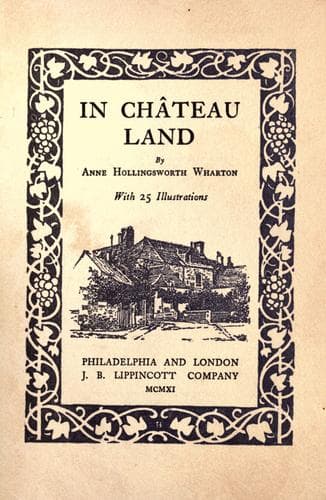
Castles -- France; Touraine (France) -- Description and travel
We left Paris yesterday from the Station Quai d'Orsay for our journey of
three and a half hours to Tours. So near to Paris is this chateau land
of Touraine that we wonder why we have not all been journeying this way
full many a year, instead of waiting to be caught up and borne hither by
the tide of fashion, especially as our route lay through a land filled
with historic and romantic associations. It is impossible to pass
through this flat but picturesque country, with its winding rivers and
white roads shaded by tall poplars, and by such old gray towns as
Etampes, Orleans, Blois, and Amboise, without recalling the delight with
which we have wandered here in such goodly company as that of Brantome,
Balzac, Dumas, and Madame de Sevigne.
It was upon this same Loire, which winds around many a chateau before it
throws itself into the sea, that Madame de Sevigne described herself as
setting forth from Tours at 5 o'clock on a May morning, in a boat, and
in the most beautiful weather in the world.
These boats on the Loire, as described by Madame de Sevigne, were
evidently somewhat like gondolas. "I have the body of my _grande
carosse_ so arranged," she wrote, "that the sun could not trouble us; we
lowered the glasses; the opening in front made a marvellous picture, all
the points of view that you can imagine. Only the Abbe and I were in
this little compartment on good cushions and in fine air, much at our
ease, altogether like _cochons sur la paille_. We had _potage et du
boulli_, quite warm, as there is a little furnace here; one eats on a
ship's plank like the king and queen; from which you see how everything
is _raffine_ upon our Loire!"
Down this same river M. Fouquet, the great financier, fled from the
wrath of his royal master and the bitter hatred of his rival Colbert. On
the swift current the lighter sped, carried along by it and the eight
rowers toward Nantes and Fouquet's own fortress of Belle Isle, only to
be overtaken by Colbert's boat with its twelve sturdy oarsmen. Whatever
may have been the sins of Fouquet, he had so many charming traits and
was so beloved by the great writers of France--Moliere, La Fontaine,
Madame de Sevigne, Pelisson, and all the rest whom he gathered around
him at his chateau--that our sympathies are with him rather than with
the cold and calculating Colbert. Putting their hands into the public
coffers was so much the habit of the financiers and royal almoners of
that period that we quite resent Fouquet's being singled out for the
horrible punishment inflicted upon him, and after all he may not have
been guilty, as justice often went far astray in those days, as in later
times.
Public-domain text, read in full here on John Shaqi.
Reviews
Reviews
No reviews yet
Be the first to share your thoughts on this work.
Join the Discussion
Join the discussion
Sign in to leave a comment or review.
Sign InorCreate an account