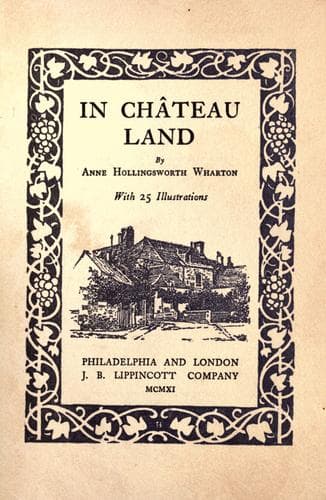
Castles -- France; Touraine (France) -- Description and travel
"It is all the same to me, good or bad," groaned Walter in reply to
Lydia's Ollendorf phrase, uttering quite audible animadversions against
foreign languages in general and the French in particular, which our
guide fortunately did not comprehend, especially as he concluded with a
crushing comparison, "Why are not all the guides like that wonderful
little woman at the Castle of Chillon, who told her story in English,
French, and German with equal fluency and facility?"
"Why, indeed!" echoed Miss Cassandra, who being a fellow sufferer is
most sympathetic.
It certainly is exasperating to a degree to have the interesting history
and traditions given forth in a language that one does not understand,
and with such rapidity that if those who are able to grasp the meaning
attempt to translate they quite lose the thread of the discourse and are
left far behind in the story.
As we passed through the great halls and spacious rooms with timbered
ceilings, tapestried walls, and beautifully tiled floors, we were
impressed with the combination of mediaeval strength and homelike
comfort, especially in the living rooms and bedrooms. The graceful mural
decorations of flowers and cherries in the Salon des Fleurs are in
strong contrast with the massive woodwork and the heavy carved
furniture, and yet the ensemble is quite harmonious. In the guard room
we noticed a fine frieze in which the arms of Anne of Brittany are
interwoven with her motto, "_Potius Mori quam Foedari!_"
From this and much more in the line of careful restoration and rich
decoration and furnishing, you may believe that the interior of Langeais
has undergone a transformation, at the hands of several owners of the
chateau, since the days when Mr. Henry James spoke of its apartments as
"not of first-class interest." M. Christophe Baron and Monsieur and
Madame Jacques Siegfried have, while preserving the distinctive
characteristics of an ancient fortress, made of Langeais an entirely
livable chateau.
Just here we are reminded by our historians that we Anglo-Saxons have a
link far back in our own history with Langeais and the cruel Fulk, Duke
of Anjou, as one of his descendants married Matilda, daughter of Henry
I, of England, and their grandson was Richard Coeur de Lion, who was
Count of Touraine and Lord of Langeais as well as King of England.
In the beautiful long salon, with its wonderful sixteenth century
tapestries and handsomely carved Spanish choir stalls, our guide became
especially eloquent, telling us that this was the room in which Charles
VIII and Anne de Bretagne were married, the inlaid table in the centre
being that upon which the marriage contract was signed.
Public-domain text, read in full here on John Shaqi.
Reviews
Reviews
No reviews yet
Be the first to share your thoughts on this work.
Join the Discussion
Join the discussion
Sign in to leave a comment or review.
Sign InorCreate an account