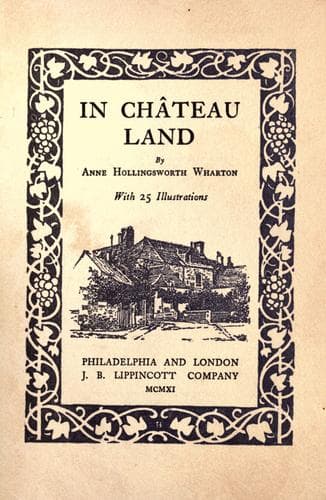
Castles -- France; Touraine (France) -- Description and travel
This was, as Walter remarks, rather shabby treatment of a royal prince
and a former suitor; but the little Queen was hot tempered, strong in
her likes and aversions, and never unmindful of the fact that she was
Duchess of Brittany in her own right, as well as Queen of France by her
marriage.
Lydia reminds us that the unappreciated Duke of Orleans had his innings
later when he became King, after the death of Charles, and the second
husband of Anne. You may notice that we are quite up on the history of
Anne of Brittany, as we came across a charming biography of her at
Brentano's in Paris, _A Twice Crowned Queen_, by the Countess de la
Warr, in addition to which we have been looking over an old copy of
Brantome that we found at a book store here.
In the three years following the death of the Dauphin two sons and a
daughter were born to Charles and Anne. These children all died in
infancy. "In vain," says the Countess de la Warr, "did Anne take every
precaution to save the lives of these little creatures whom death
snatched from her so ruthlessly. She summoned nurses from Brittany, and
the superstitious beliefs of her own country came back to her mind. She
presented them with amulets, a Guienne crown piece wrapped up in paper,
a piece of black wax in a bag of cloth of gold, six serpents'
tongues,--a large one, two of medium size, and three little ones,--and
rosaries of chalcedony and jasper; she not only sent votive offerings to
the venerated shrines of the saints in Brittany, and presented rich
gifts every year to the Holy Virgin of Auray, but she went herself on a
pilgrimage. Alas! it was all to no purpose; a relentless fate followed
the poor Queen."
A still heavier blow was destined to fall upon Anne, a few years later,
in the death of her husband, to whom she seems to have been devotedly
attached. In the midst of his work of beautifying Amboise with the
spoils of his Italian wars, Charles was suddenly struck down with
apoplexy, induced it is thought by a blow. He hit his head, never a very
strong one, according to all accounts, against the stone arch of a
little doorway and died a few hours after. We were shown the entrance to
the Galerie Hacquelebac where the King met with his fatal accident as he
was on his way to the tennis court with the Queen and his confessor, the
Bishop of Angers. The door, which was very low at that time, was later
raised and decorated with the porcupine of Louis XII.
Public-domain text, read in full here on John Shaqi.
Reviews
Reviews
No reviews yet
Be the first to share your thoughts on this work.
Join the Discussion
Join the discussion
Sign in to leave a comment or review.
Sign InorCreate an account