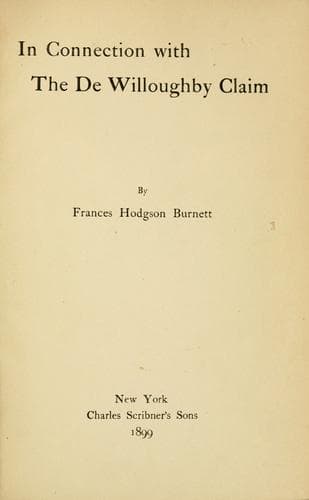
In Connection with the De Willoughby ClaimBurnett, Frances Hodgson
General
In Connection with the De Willoughby Claim
Burnett, Frances Hodgson
United States -- Social life and customs -- 19th century -- Fiction
"It is that we shall be friends--friends."
Baird laid his hand on the man's gaunt shoulder with a nervous grasp as
he spoke, and his voice was unsteady.
"I have never had a friend," answered Latimer, monotonously; "I should
scarcely know what to do with one."
"Then it is time you had one," Baird replied. "And I may have something
to offer you. There may be something in--in my feeling which may be worth
your having."
He held out his hand.
Latimer looked at it for a second, then at him, his sallow face flushing
darkly.
"You are offering me a good deal," he said, "I scarcely know
why--myself."
"But you don't take my hand, Latimer," Baird said; and the words were
spoken with a faint loss of colour.
Latimer took it, flushing more darkly still.
"What have I to offer in return?" he said. "I have nothing. You had
better think again. I should only be a kind of shadow on your life."
"I want nothing in return--nothing," Baird said. "I don't even ask
feeling from you. Be a shadow on my life, if you will. Why should I have
no shadows? Why should all go smoothly with me, while others----" He
paused, checking his vehemence as if he had suddenly recognised it. "Let
us be friends," he said.
CHAPTER XV
The respectable portion of the population of Janway's Mills believed in
church-going and on Sunday-school attendance--in fact, the most entirely
respectable believed that such persons as neglected these duties were
preparing themselves for damnation. They were a quiet, simple, and
unintellectual people. Such of them as occasionally read books knew
nothing of any literature which was not religious. The stories they had
followed through certain inexpensive periodicals were of the order which
describes the gradual elevation of the worldly-minded or depraved to the
plane of church-going and Sunday-school. Their few novels made it their
_motif_ to prove that it is easier for a camel to pass through the eye of
a needle than for a rich man to enter into the Kingdom of Heaven. Any
hero or heroine of wealth who found peace of mind and married happily,
only attained these objects through the assistance of some noble though
humble unsecular person whose example and instruction led them to adopt
unsecular views. The point of view of Janway's Mills was narrow and far
from charitable when it was respectable; its point of view, when it was
not respectable, was desperate. Even sinners, at Janway's Mills, were
primitive and limited in outlook. They did not excuse themselves with
specious argument for their crimes of neglecting church-going, using bad
language, hanging about bar-rooms, and loose living. They were not
brilliant wrongdoers and made no attempt at defending themselves or
pretending that they did not know they were going to perdition. The New
England mind is not broad or versatile, and, having begun life in a
Puritan atmosphere, it is not quick to escape its influence. Society at
the Mills recognised no social distinction which was not founded upon the
Public-domain text, read in full here on John Shaqi.
Reviews
Reviews
No reviews yet
Be the first to share your thoughts on this work.
Elsewhere in the archive
Join the Discussion
Join the discussion
Sign in to leave a comment or review.
Sign InorCreate an account