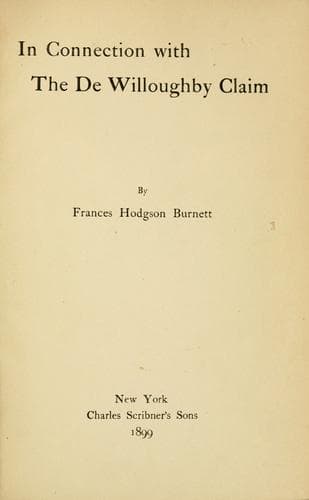
In Connection with the De Willoughby ClaimBurnett, Frances Hodgson
General
In Connection with the De Willoughby Claim
Burnett, Frances Hodgson
United States -- Social life and customs -- 19th century -- Fiction
respectability of church-going and the observance of social laws made by
church-goers; it recognised none because it absolutely _knew_ of none.
The great world was not far from Janway's Mills, but they did not touch
each other. Willowfield was near, Boston and New York themselves were not
far distant, but the curious fact being that millions of human minds may
work and grow and struggle as if they were the minds of dwellers upon
another planet, though less than a hundred miles may separate them, the
actual lives, principles, and significances of the larger places did not
seem to touch the smaller one. The smaller one was a village of a few
streets of small houses which had grown up about the Mills themselves.
The Mills gave employment to a village full of hands, so the village
gradually evolved itself. It was populated by the uneducated labouring
class; some were respectable, some were dissolute and lived low and gross
lives, but all were uneducated in any sense which implies more than the
power to read, write, and make a few necessary calculations. Most of them
took some newspaper. They read of the multi-millionaires who lived in New
York and Chicago and California, they read of the politicians in
Washington, they found described to them the great entertainments given
by millionaires' wives and daughters, the marvellous dresses they wore,
the multifarious ways in which they amused themselves, but what they read
seemed so totally unlike anything they had ever seen, so far apart from
their own lives, that though they were not aware of the fact, the truth
was that they believed in them with about the same degree of realisation
with which they believed in what they heard in the pulpit of the glories
of the New Jerusalem. No human being exists without an ambition, and the
ambition of Janway's Millers of the high-class was to possess a neat
frame-house with clean Nottingham lace curtains at the windows, fresh
oilcloth on the floor of the front hall, furniture covered with green or
red reps in the parlour, a tapestry Brussels carpet, and a few
lithographs upon the walls. It was also the desire of the owners of such
possessions that everyone should know that they attended one of the
churches, that their house-cleaning was done regularly, that no member of
the family frequented bar-rooms, and that they were respectable people.
It was an ambition which was according to their lights, and could be
despised by no honest human being, however dull it might appear to him.
It resulted oftener than not in the making of excellent narrow lives
which brought harm to no one. The lives which went wrong on the
street-corners and in the bar-rooms often did harm. They produced
discomfort, unhappiness, and disorder; but as it is also quite certain
that no human being produces these things without working out his own
punishment for himself while he lives on earth, the ends of justice were
doubtless attained.
Public-domain text, read in full here on John Shaqi.
Reviews
Reviews
No reviews yet
Be the first to share your thoughts on this work.
Elsewhere in the archive
Join the Discussion
Join the discussion
Sign in to leave a comment or review.
Sign InorCreate an account