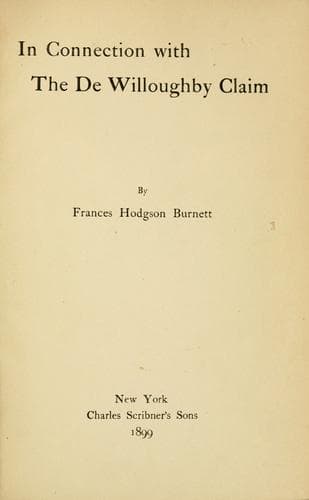
In Connection with the De Willoughby ClaimBurnett, Frances Hodgson
General
In Connection with the De Willoughby Claim
Burnett, Frances Hodgson
United States -- Social life and customs -- 19th century -- Fiction
When the girl Susan Chapman fell into misfortune and disgrace, her path
was not made easy for her. There were a few months when the young mill
hand who brought disaster upon her, made love to her, and hung about her
small home, sometimes leaning upon the rickety gate to talk and laugh
with her, sometimes loitering with her in the streets or taking her to
cheap picnics or on rather rowdy excursions. She wore the excited and
highly pleased air seen in young women of her class when the masculine
creature is paying court. She spent her wages in personal decoration, she
bought cheap feathers and artificial flowers and remnants on "bargain
days," and decked herself with them. Her cheap, good looks reached their
highest point because she felt the glow of a promotive triumph and her
spirits were exhilarated. She was nearer happiness than she had ever been
before. The other girls, who were mill hands like herself, were full of
the usual rather envious jokes about her possible marriage. To be married
was to achieve a desirable distinction and to work at home instead of at
the Mills. The young man was not an absolute villain, he was merely an
ignorant, foolish young animal. At first he had had inchoate beliefs in a
domestic future with the girl. But the time came when equally inchoate
ideas of his own manhood led him to grow cool. The New England atmosphere
which had not influenced him in all points, influenced him in the matter
of feeling that the woman a man married must have kept herself
respectable. The fact that he himself had caused her fall from the plane
of decency was of comparatively small moment.
A man who married a woman who had not managed to keep straight, put
himself into a sort of ridiculous position. He lost masculine
distinction. This one ceased to lean on the gate and talk at night, and
went to fewer picnics. He was in less high spirits, and so was the girl.
She often looked pale and as if she had been crying. Then Jack Williams
gave up his place at the Mill and left the village. He did not tell his
sweetheart. The morning after he left, Susan came to her work and found
the girls about her wearing a mysterious and interested air.
"What are you whispering about?" she asked. "What's the secret?"
"'Tain't no secret," was the answer. "Most everybody's heard it, and I
guess it ain't no secret to you. I guess he told you when he made up his
mind to go."
"Who?" she asked.
"Jack Williams. He's gone out to Chicago to work somewhere there. He kept
it pretty dark from us, but when he went off on the late train last
night, Joe Evans saw him, and he said he'd had the offer of a first-rate
job and was going to it. How you stare, Sue! Your eyes look as if they'd
pop out o' yer head."
Public-domain text, read in full here on John Shaqi.
Reviews
Reviews
No reviews yet
Be the first to share your thoughts on this work.
Elsewhere in the archive
Join the Discussion
Join the discussion
Sign in to leave a comment or review.
Sign InorCreate an account