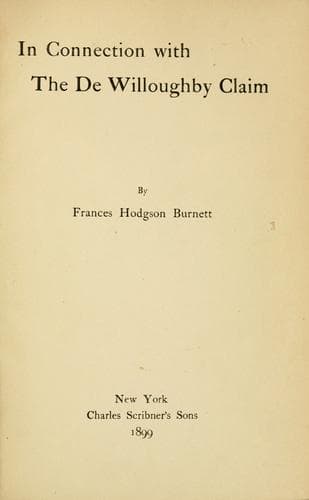
In Connection with the De Willoughby ClaimBurnett, Frances Hodgson
General
In Connection with the De Willoughby Claim
Burnett, Frances Hodgson
United States -- Social life and customs -- 19th century -- Fiction
She was staring and her skin had turned blue-white. She broke into a
short hysteric laugh and fell down. Then she was very sick and fainted
and had to be taken home trembling so that she could scarcely crawl as
she walked, with great tears dropping down her cold face. Janway's Mills
knew well enough after this that Jack Williams had deserted her, and had
no hesitation in suggesting a reason for his defection.
The months which followed were filled with the torments of a squalid
Inferno. Girls who had regarded her with envy, began to refuse to speak
to her or to be seen in her company. Jack Williams's companions were
either impudent or disdainful, the married women stared at her and
commented on her as she passed; there were no more picnics or excursions
for her; her feathers became draggled and hung broken in her hat. She had
no relatives in the village, having come from a country place. She was
thankful that she had not a family of aunts on the spot, because she knew
they would have despised her and talked her over more than the rest. She
lived in a bare little room which she rented from a poor couple, and she
used to sit alone in it, huddled up in a heap by the window, crying for
hours in the evening as she watched the other girls go by laughing and
joking with their sweethearts.
One night when there was a sociable in the little frame Methodist church
opposite, and she saw it lighted up and the people going in dressed in
their best clothes and excited at meeting each other, the girls giggling
at the sight of their favourite young men--just as she had giggled six
months before--her slow tears began to drip faster and the sobs came one
upon another until she was choked by them and she began to make a noise.
She sobbed and cried more convulsively, until she began to scream and
went into something like hysterics. She dropped down on her face and
rolled over and over, clutching at her breast and her sides and throwing
out her arms. The people of the house had gone to the sociable and she
was alone, so no one heard or came near her. She shrieked and sobbed and
rolled over and over, clutching at her flesh, trying to gasp out words
that choked her.
"O, Lord!" she gasped, wild with the insensate agony of a poor, hysteria
torn, untaught, uncontrolled thing, "I don't know what I've done! I
don't! 'Tain't fair! I didn't go to! I can't bear it! He h'ain't got
nothin' to bear, he ain't! O, Lord God, look down on me!"
She was the poor, helpless outcome of the commonest phase of life, but
her garret saw a ghastly tragedy as she choked through her hysterics. Who
is to blame for and who to prevent such tragedies, let deep thinkers
strive to tell.
Public-domain text, read in full here on John Shaqi.
Reviews
Reviews
No reviews yet
Be the first to share your thoughts on this work.
Elsewhere in the archive
Join the Discussion
Join the discussion
Sign in to leave a comment or review.
Sign InorCreate an account