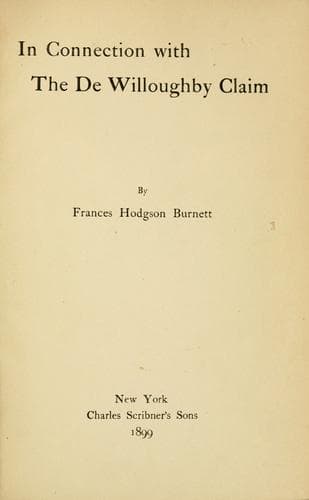
In Connection with the De Willoughby ClaimBurnett, Frances Hodgson
General
In Connection with the De Willoughby Claim
Burnett, Frances Hodgson
United States -- Social life and customs -- 19th century -- Fiction
This was before Margery went to Boston to try to develop her gift for
making pretty sketches. Her father and mother and her brother strained
every nerve to earn and save the money to cover her expenses. She went
away full of innocent, joyous hope in the month of May. She boarded in a
plain, quiet house, and had two rooms. One was her workroom and studio.
She worked under a good-natured artist, who thought her a rather gifted
little creature and used to take her to look at any pictures that were on
exhibition. Taking into consideration her youth and limited advantages,
she made such progress as led him to say that she had a future before
her.
She had never deserted Sue Chapman after that first morning in which she
had gone to her rescue. Janway's Mills was bewildered when it found that
the Reverend Lucien Latimer's sister went to see Jack Williams' deserted
sweetheart, and did not disdain to befriend her in her disgrace. The
church-going element, with the Nottingham lace curtains in its parlour
windows, would have been shocked, but that it was admitted that "the
Latimers has always been a well-thought-of family, an' all of 'em is
members in good standin'. They're greatly respected in Willowfield; even
the old fam'lies speak to 'em when they meet 'em in the street or at
Church.
"Not that I'd be willin' for my Elma Ann to 'sociate with a girl that's
gone wrong. Maybe it's sorter different with a minister's sister.
Ministers' families has to 'sociate out o' charity an' religion; go to
pray with 'em, an' that, an' read the Scripture to make 'em sense their
sinfulness an' the danger they're in."
But Margery did not pray with Susan Chapman, or read the Bible to her.
The girl held obstinately to her statement of unbelief in a God, and
Margery did not feel that her mood was one to which reading the Gospel
would appeal. If she could have explained to her the justice of the
difference between Jack Williams' lot and her own, she felt they might
have advanced perhaps, but she could not. She used to go to see her and
try to alleviate her physical discomfort and miserable poverty. She saved
her from hunger and cold when she could no longer work at all, and she
taught her to feel that she was not utterly without a friend.
Public-domain text, read in full here on John Shaqi.
Reviews
Reviews
No reviews yet
Be the first to share your thoughts on this work.
Elsewhere in the archive
Join the Discussion
Join the discussion
Sign in to leave a comment or review.
Sign InorCreate an account