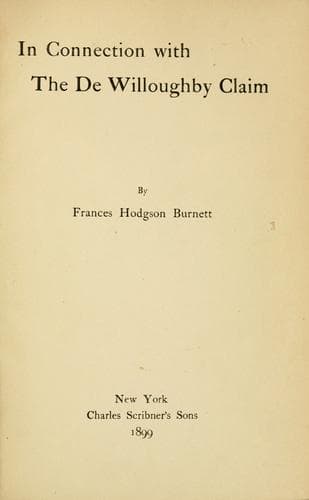
In Connection with the De Willoughby ClaimBurnett, Frances Hodgson
General
In Connection with the De Willoughby Claim
Burnett, Frances Hodgson
United States -- Social life and customs -- 19th century -- Fiction
She did not know the girl at all, she had never even heard of her before,
but she kissed her hand and cried over it and fondled it against her
breast. She was one of those human things created by Nature to suffer
with others, and for them, and through them.
She did not know how long it was before the girl became sufficiently,
articulate to speak to her. She herself was scarcely articulate for some
time. She could only try to find words to meet a need so far beyond her
ken. She had never come in contact with a woman in this strait before.
But at last Susan was lying in the bed instead of on its tossed and
tumbled outside. Margery had done the nearest, simple things for her. She
had helped her to bathe her face with cold water, to undress and put on
her nightgown; she had prepared her narrow bed for her decently, and
smoothed and wound up her hair. Then she had gone downstairs, got her a
cup of tea, and sat by her and made her drink it. Then she set the room
in order and opened the window to air it.
"There is a bruise on your forehead," she had said, as she was arranging
the torn hair. "You must have struck it against something when you were
ill last night."
"I struck it against the wall," Susan answered, in a monotonous voice. "I
did it on purpose. I banged my head against the wall until I fell down
and was sick."
Margery's face quivered again.
"Don't think about it," she said. "You ought not to have been alone.
Some--some friend ought to have been with you."
"I haven't got any friends," Susan answered. "I don't know why you came
up to me. I don't guess you know what's the matter with me."
"Yes, I do," said Margery. "You are in great trouble."
"It's the worst kind o' trouble a woman can get into," said Susan, the
muscles of her face beginning to be drawn again. "I don't see why--why
Jack Williams can skip off to Chicago to a new, big job that's a stroke
o' luck--an' me left lie here to bear everything--an' be picked at, an'
made fun of, an' druv mad with the way I'm kicked in the gutter. I don't
see no _right_ in it. There _ain't_ no right in it; I don't believe
there's no God anyhow; I won't never believe it again. No one can't make
me. If I've done what gives folks a right to cast me off, so's Jack
Williams."
"You haven't pretended to love a person and then run away and left them
to--to suffer," said little Margery, on the verge of sobs again.
"No, I haven't!" said the girl, her tears beginning to stream anew. "I'm
not your kind. I'm not educated. I'm only a common mill hand, but I did
love Jack Williams all I knew how. He had such a nice way with him--kind
of affectionate, an'--an' he was real good-lookin' too when he was fixed
up. If I'd been married to him, no one would have said nothin', an'--an'
'tain't nothin' but a minister readin' somethin' anyhow--marryin' ain't."
CHAPTER XVI
Public-domain text, read in full here on John Shaqi.
Reviews
Reviews
No reviews yet
Be the first to share your thoughts on this work.
Elsewhere in the archive
Join the Discussion
Join the discussion
Sign in to leave a comment or review.
Sign InorCreate an account