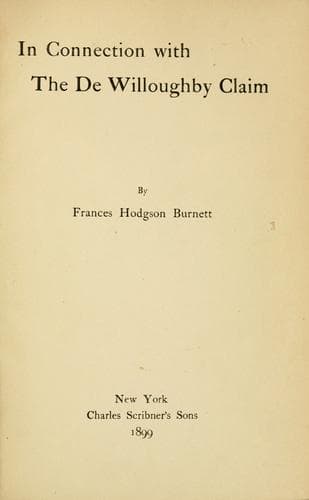
In Connection with the De Willoughby ClaimBurnett, Frances Hodgson
General
In Connection with the De Willoughby Claim
Burnett, Frances Hodgson
United States -- Social life and customs -- 19th century -- Fiction
"Oh," she exclaimed. "No one knows what a good brother he is--nobody but
myself. He is willing to give up everything to--to save me--and to save
poor mother from awful trouble. Sometimes I think he is something like
Christ--even like Christ! He is willing to suffer for other people--for
their pain--and weakness--and sin."
It was so evident that the change which had taken place in her was a
woeful one. Her bright loveliness was gone--her simple, lovable
happiness. Her nerves seemed all unstrung. But it was the piteous,
strained look in her childlike eyes which stirred poor Susan's breast to
tumult.
"Margery," she said, almost trembling, "if--if--if you was to go in a
consumption and die--you're not like me--you needn't be afraid."
The next moment she was sorry she had said the crude thing. Margery burst
into a passion of weeping. Susan flew to her and caught her in her arms,
kneeling down by her.
"I oughtn't to have said it," she cried. "You're too ill to be made to
think of such things. I was a fool not to see--Margery, Margery, don't!"
But Margery was too weak to be able to control her sobbing.
"They say that--that God forgives people," she wept. "I've prayed and
prayed to be forgiven for--for my sins. I've never meant to be wicked. I
don't know--I don't know how----"
"Hush!" said Susan, soothing and patting her trembling shoulder. "Hush,
hush! If there _is_ a God, Margery, He's a heap sight better than we give
Him credit for. He don't make people a' purpose, so they can't help
things somehow--an' don't know--an' then send 'em to burning hell for
_bein'_ the way He made 'em. _We_ wouldn't do it, an' He won't. You
hain't no reason to be afraid of dyin'."
Margery stayed with her about half an hour. There was a curious element
in their conversation. They spoke as if their interview was a final one.
Neither of them actually expressed the thought in words, but a listener
would have felt vaguely that they never expected to meet each other again
on earth. They made no references to the future; it was as if no future
could be counted upon. Afterwards, when she was alone, Susan realised
that she had never once said "when you come back from Europe."
As she was leaving the room, Margery passed the bed on which the small,
coarse garments lay. The little nightgown, with its short sleeves stiffly
outstretched, seemed to arrest her attention specially. She caught at
Susan's dress as if she was unaware that she made the movement or of the
sharp shudder which followed it.
"Those--are its things, aren't they, Susan?" she said.
"Yes," Susan answered, her sullen look of pain coming back to her face.
"I--don't know--how people _bear_ it!" exclaimed Margery. It was an
exclamation, and her hand went quickly up to her mouth almost as if to
press it back.
Public-domain text, read in full here on John Shaqi.
Reviews
Reviews
No reviews yet
Be the first to share your thoughts on this work.
Elsewhere in the archive
Join the Discussion
Join the discussion
Sign in to leave a comment or review.
Sign InorCreate an account