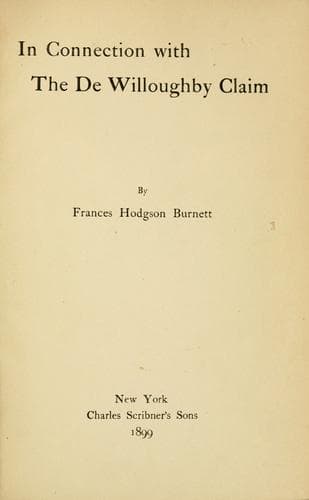
In Connection with the De Willoughby ClaimBurnett, Frances Hodgson
General
In Connection with the De Willoughby Claim
Burnett, Frances Hodgson
United States -- Social life and customs -- 19th century -- Fiction
"They don't _bear_ it," said Susan, stonily. "They have to go through
it--that's all. If you was standin' on the gallows with the rope round
your neck and the trap-door under your feet, you wouldn't be bearin' it,
but the trap-door would drop all the same, an' down you'd plunge--into
the blackness."
It was on this morning, on her way through the streets, that Margery
dropped in a dead faint upon the pavement, and Miss Amory Starkweather,
passing in her carriage, picked her up and carried her home.
Susan Chapman never saw her again. Some months afterwards came the rumour
that she had died of consumption in Italy.
CHAPTER XVII
When, in accordance with Baird's instructions, Susan Chapman took the
note to Miss Starkweather, she walked through the tree-shaded streets,
feeling as if she had suddenly found herself in a foreign country. To the
inhabitants of Janway's Mills, certain parts of Willowfield stood for
wealth, luxury, and decorous splendour. The Mills, which lived within
itself, was easily impressed. Its--occasionally resentful--respect for
Willowfield was enormous. It did not behold it as a simple provincial
town, whose business establishments were primitive, and whose frame
houses, even when surrounded by square gardens with flower-beds adorning
them, were merely comfortable middle-class abodes of domesticity. It was
awed by the Willowfield _Times_, it revered the button factory, and
bitterly envied the carriages driven and the occasional festivities held
by the families of the representatives of these monopolies. The carriages
were sober and middle-aged, and so were the parties, but to Janway's
Mills they illustrated wealth and gaiety. People drove about in the
vehicles and wore fine clothes and ate cakes and ice-cream at the
parties--neither of which things had ever been possible or ever would
become possible to Janway's.
And Susan, who had been a Pariah and an outcast at the Mills, was walking
through the best streets, carrying a note from the popular minister to
the rich Miss Starkweather, who had an entire square white frame house
and garden, which were her own property.
The girl felt a little sullen and a little frightened. She did not know
what would happen to her; she did not know how she would be expected to
carry herself in a house so representative of wealth and accustomedness
to the good things of life. Perhaps if she had not been desperate, and
also, if she had not known that Miss Starkweather had been fond of
Margery, she would have evaded going to her.
"I wonder what she'll say to me," she thought. "They say she's queer."
Public-domain text, read in full here on John Shaqi.
Reviews
Reviews
No reviews yet
Be the first to share your thoughts on this work.
Elsewhere in the archive
Join the Discussion
Join the discussion
Sign in to leave a comment or review.
Sign InorCreate an account