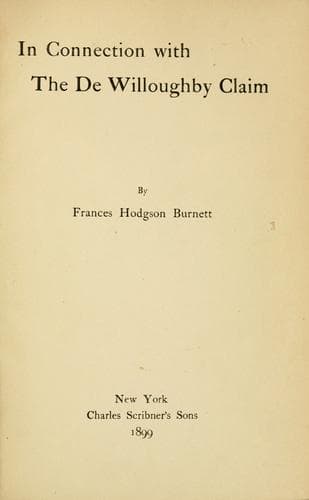
In Connection with the De Willoughby ClaimBurnett, Frances Hodgson
General
In Connection with the De Willoughby Claim
Burnett, Frances Hodgson
United States -- Social life and customs -- 19th century -- Fiction
She still felt uncertain and resentful when she stood upon the threshold
and rang the bell. She presented a stolid countenance to the maid servant
who opened the door and received her message. When she was at last taken
to Miss Amory, she went with an unresponding bearing, and, being led into
a cheerful room where the old woman sat, stood before her waiting, as if
she had really nothing to do with the situation.
Miss Amory looked rather like some alert old hawk, less predatory by
instinct than those of his species usually are.
"You are Susan Chapman, and come from Mr. Baird," she said.
Susan nodded.
"He says he met you at Mr. Latimer's."
"Yes. I went there to ask something. I couldn't bear not to know--no more
than I did."
"About----?" asked Miss Amory.
"About Margery," her voice lowering unconsciously.
"How much did you know?" Miss Amory asked again.
"Nothin'," rather sullenly, "but that she was ill--an' went away an'
died."
"In Italy, they say," put in Miss Amory--"lying on a sofa before an open
window--on a lovely day, when the sun was setting."
Susan Chapman started a little, and her face changed. The unresponsiveness
melted away. There was something like a glow of relief in her look. She
became human and lost sight of Miss Amory's supposed grandeur.
"Was it like that?" she exclaimed. "Was it? I'm thankful to you for
telling me. Somehow I couldn't ask properly when I was face to face with
her brother. You can't talk to him. I never knew where--or how--it was. I
wanted to find out if--if it was all right with her. I wanted to know she
hadn't suffered."
"So did I," Miss Amory answered. "And that was what they told me."
She passed her withered hand across her face.
"I was fond of her," she said.
"I'd _reason_ to be," returned Susan. "She was only a delicate little
young thing--but she came an' stayed by me when I was in hell an' no one
else would give me a drop of water to cool my tongue."
"I know something about that," said Miss Amory; "I have heard it talked
of. Where's your child?"
Susan did not redden, but the hard look came back to her face for a
moment.
"It didn't live but a few minutes," she answered.
"What are you doing for your living?"
A faint red showed itself on the girl's haggard cheeks, and she stared at
her with indifferent blankness.
"I worked in the mill till my health broke down for a spell, an' I had to
give up. I'm better now, but I've not got a cent to live on, an' my place
was filled up right away."
"Where's the man?" Miss Amory demanded.
"I don't know. I've never heard a word of him since he slid off to
Chicago."
"Humph!" said Miss Amory.
For a moment or so she sat silent, thinking. She held her chin in her
hand and pinched it. Presently she looked up.
Public-domain text, read in full here on John Shaqi.
Reviews
Reviews
No reviews yet
Be the first to share your thoughts on this work.
Elsewhere in the archive
Join the Discussion
Join the discussion
Sign in to leave a comment or review.
Sign InorCreate an account