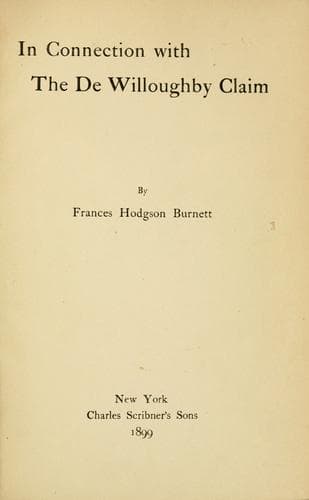
In Connection with the De Willoughby ClaimBurnett, Frances Hodgson
General
In Connection with the De Willoughby Claim
Burnett, Frances Hodgson
United States -- Social life and customs -- 19th century -- Fiction
The old woman paused a few moments on the garden walk and turned her face
upward to look at the blue height and expanse of sky. There was a shade
of desperate appeal or question on her uplifted, rugged countenance.
"When the world gets too much for me," she said, "and I lose my patience
with the senselessness of the tragedy of it, I get a sort of courage from
looking up like this--into the height and the still, clear blueness. It
sends no answer back to me--that my human brain can understand--but it
makes me feel that perhaps there is no earth at all. I get out of it and
away."
"I know--I know--though I am not like you," Baird said, slowly.
Miss Amory came back to earth with a curious look in her eyes.
"Yes," she answered, "I should think that perhaps you are one of those
who know. But one has to have been desperate before one turns to it as a
resource. It's a last one--and the unmerciful powers only know why we
should feel it a resource at all. As I said, it does not answer back. And
we want answers--answers."
Then they went on walking.
"That poor thing has been a woman at least," said Miss Amory. "I have
been a sort of feminine automaton. I have been respectable and she has
not. All good women are not respectable and all respectable women are not
good. That's a truism so absolute that it is a platitude, and yet there
still exist people to whom it would appear a novel statement. That poor
creature has loved and had her heart broken. She has suffered the whole
gamut of things. She has been a wife without a name, a mother without a
child. She is full of crude tragedy. And I have found out already that
she is good--good."
"What is goodness?" asked Baird.
Miss Amory gave him another of her sharp looks.
"You are drawing me out," she said. "I'm not really worth it. Goodness is
quite different from respectability. Respectability is a strict keeping
of the laws men have made to oblige other men to do or not to do the
things they want done or left undone. The large meaning of the law is
punishment. No law, no punishment; no punishment, no law. And man made
both for man. If you keep man's law you will be respectable, but you may
not be good. Jesus Christ was not respectable--no one will deny that.
Goodness, after all, means doing all kindness to all creatures, and,
above all, doing no wrong to any. That's all. Are you good?"
"No," he answered, "I am not."
"You would probably find it more difficult to be so than I should," she
responded. "And I find it hard enough--without being handicapped by
beauty and the pleasure-loving temperament. You were started well on the
road to the devil when you were born. Your very charms and virtues were
ready to turn out vices in disguise. But when such things happen----" and
she shrugged her lean shoulders. "As we have no one else to dare to
blame, we can only blame ourselves. In a scheme so vague every man must
be his own brake."
Public-domain text, read in full here on John Shaqi.
Reviews
Reviews
No reviews yet
Be the first to share your thoughts on this work.
Elsewhere in the archive
Join the Discussion
Join the discussion
Sign in to leave a comment or review.
Sign InorCreate an account