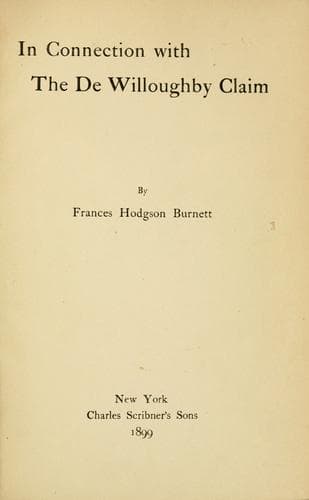
In Connection with the De Willoughby ClaimBurnett, Frances Hodgson
General
In Connection with the De Willoughby Claim
Burnett, Frances Hodgson
United States -- Social life and customs -- 19th century -- Fiction
Baird drew a sharp breath. "If one only knew that early enough," he
exclaimed.
Miss Amory laughed harshly.
"Yes," she said, "part of the vagueness of the scheme--if it _is_ a
scheme--is that it takes half a lifetime to find it out. Before that, we
are always either telling ourselves that we are not going to do any harm,
or that we are under the guidance of a merciful Providence."
"That we are not going to do any harm," Baird repeated, "that we are not
going to do any harm. And suddenly it's done."
"And can't be undone," Miss Amory added. "That's it."
The girl, Susan Chapman, was watching them from a window as they walked
and talked. She bit her lips anxiously as she stood behind the curtain.
She was trying to imagine what they might be saying to each other.
Suppose it was something which told against her. And why should it not be
so? What good could be said? Janway's Mills had borne in upon her the
complete sense of her outcast state. While professing a republican
independence of New England spirit, the place figuratively touched its
forehead to the earth before Miss Starkweather. She lived on an income
inherited from people who had owned mills instead of working them; who
employed--and discharged--hands. She would have been regarded as an
authority on any subject, social or moral. And yet it was she who had
spoken the first lenient word to a transgressor of the unpardonable type.
Susan had been dumfounded at first, and then she had begun to be afraid
that the leniency arose from some mistake Miss Amory would presently
discover.
"Perhaps he's heard and he's telling her now," she said, breathlessly, as
she looked into the garden. "Maybe she'll come in and order me out." She
looked down at her clean dress, and a sob rose in her throat at the
realisation of the mere physical comfort she had felt during the last
hour or two--the comfort of being fed and clothed and enclosed within
four walls. If she was to be cast back into outer darkness again it would
be better to know at once.
When Baird had gone away and Miss Amory was sitting by her window, Susan
appeared before her again with an ashen complexion and a set look. She
stood a moment, hesitating, her hands clasping her elbows behind her
back.
"You want to say something to me?" said Miss Amory.
"Yes," the girl answered. "Yes, I do--an' I don't know how. Are you sure,
ma'am, are you sure you know quite how bad I have been?"
"No," said Miss Amory; "sit down and tell me, Susan."
She said it with an impartiality so serenely free from condemnation that
Susan's obedient sitting down was almost entirely the result of not being
able to stand up. She, so to speak, fell into a chair and leaned forward,
covering her face with her hands.
"I don't believe you know," she whispered.
"By experience I know next to nothing," Miss Amory answered, "but my
imagination and my reason tell me a great deal. You were not married and
you had a child. You lost your health and your work----"
Public-domain text, read in full here on John Shaqi.
Reviews
Reviews
No reviews yet
Be the first to share your thoughts on this work.
Elsewhere in the archive
Join the Discussion
Join the discussion
Sign in to leave a comment or review.
Sign InorCreate an account