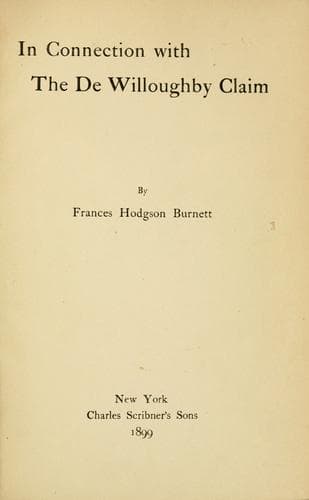
In Connection with the De Willoughby Claim — John Shaqi
In Connection with the De Willoughby ClaimBurnett, Frances Hodgson
General
In Connection with the De Willoughby Claim
Burnett, Frances Hodgson
United States -- Social life and customs -- 19th century -- Fiction
About a week later Delia Vanuxem appeared upon the scene. Delia Vanuxem
was a young cousin of Mrs. De Willoughby's, and had come to pay her
relatives a visit. It was the hospitable custom of Delisleville to
cultivate its kinsfolk--more especially its kinswomen. There were always
in two or three of the principal families young lady guests who were
during their stay in the town the sensation of the hour. Novelty
established them as temporary belles; they were petted by their
hostesses, attended by small cohorts of admirers, and formed the centre
for a round of festivities specially arranged to enliven their visits.
Delia Vanuxem bore away the palm from all such visitors past or to come.
She was a true Southern beauty, with the largest dark eyes, the prettiest
yielding manner, and the very smallest foot Delisleville had ever fallen
prostrate before, it being well known among her admirers that one of her
numerous male cousins had once measured her little slipper with a
cigar--a story in which Delisleville delighted. And she was not only a
pretty, but also a lovable and tender-hearted young creature. Her soft
eyes end soft voice did not belie her. She was gentle and kindly to all
around her. Mrs. De Willoughby and the two older girls fell in love with
her at once, and the Judge himself was aroused to an eloquence of
compliment and a courtly grandeur of demeanour which rose even beyond his
usual efforts in a line in which he had always shone. The very negroes
adored her and vied with each other to do her service.
It was quite natural that a nature so sweet and sympathetic should be
awakened to pity for the one member of the gay household who seemed cut
off from the rest, and who certainly at the time existed under a darker
cloud than usual.
From the first she was more considerate of poor Tom than anyone who had
ever been before, and more than once, as he sat silent and gloomy at the
table, he looked up to find her lovely eyes resting upon his big frame
with a questioning, pitying glance.
"He is so much too big, Aunt Jule," she wrote home once. "And he seems
somehow to feel as if he was always in the way, and, indeed, he is a
little sometimes, poor fellow! and everyone appears to think he is only a
joke or a mistake; but I have made up my mind never to laugh at him at
all as the other girls do. It seems so unkind, and surely he must feel
it."
She never did laugh at him, and sometimes even tried to talk to him, and
once drew him out so far in an artful, innocent way, that he told her
something of his medical failure and the reasons for it, manifestly
ashamed of the story as he related it, and yet telling it so well in a
few clumsy, rather disconnected sentences, that when he had finished her
eyelashes were wet and she broke into a little shuddering sigh.
Public-domain text, read in full here on John Shaqi.
Reviews
Reviews
No reviews yet
Be the first to share your thoughts on this work.
Join the Discussion
Join the discussion
Sign in to leave a comment or review.
Sign InorCreate an account