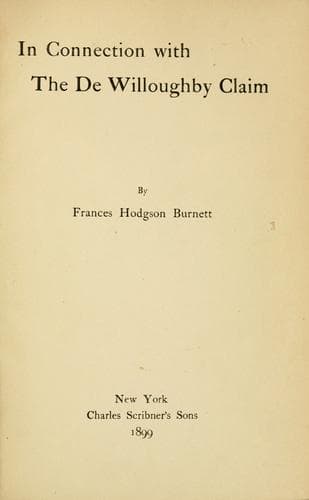
In Connection with the De Willoughby ClaimBurnett, Frances Hodgson
General
In Connection with the De Willoughby Claim
Burnett, Frances Hodgson
United States -- Social life and customs -- 19th century -- Fiction
But there was no modifying the outburst of wonder and condemnation which
overwhelmed him. To side with the Union--in an aristocratic Southern
town--was to lose social caste and friends, to be held a renegade and an
open, degraded traitor to home and country. At that period, to the
Southerner the only country was the South--in the North reigned outer
darkness. Had the Judge been a poor white, there would have been talk of
tar and feathers. As a man who had been a leader among the aristocratic
classes, he was ostracized. In the midst of his financial disasters he
was treated as an outlaw. He had been left a widower a few years before,
during the war his son De Courcy died of fever, Romaine fell in battle,
and his sole surviving daughter lost her life through diphtheria
contracted in a soldiers' hospital. The family had sunk into actual
poverty; the shock of sorrows and disappointment broke the old man's
spirit. On the day that peace was finally declared he died in his room in
the old house which had once been so full of young life and laughter and
spirit.
The only creature with him at the time was his grandson, young Rupert De
Willoughby, who was De Courcy's son. The sun was rising, and its first
beams shone in at the open window rosily. The old Judge lay rubbing his
hands slowly together, perhaps because they were cold.
"Only you left, Rupert," he said, "and there were so many of us. If
Tom--if Tom had not been such a failure--don't know whether he's
alive--or dead. If Tom----"
His hands slowly ceased moving and his voice trailed off into silence.
Ten minutes later all was over, and Rupert stood in the world entirely
alone.
* * * * *
For the next two years the life the last De Willoughby lived in the old
house, though distinctly unique, was not favourable to the development of
youth. Having been prepared for the practice of the law, after the
time-honoured De Willoughby custom, and having also for some months
occupied a corner in the small, unbusiness-like, tree-shaded, brick
building known as the Judge's "office," Rupert sat now at his
grandfather's desk and earned a scant living by endeavouring to hold
together the old man's long-diminished practice. The profession at the
time offered nothing in such places as Delisleville, even to older and
more experienced men. No one had any money to go to law with, few had any
property worth going to law about.
Public-domain text, read in full here on John Shaqi.
Reviews
Reviews
No reviews yet
Be the first to share your thoughts on this work.
Elsewhere in the archive
Join the Discussion
Join the discussion
Sign in to leave a comment or review.
Sign InorCreate an account