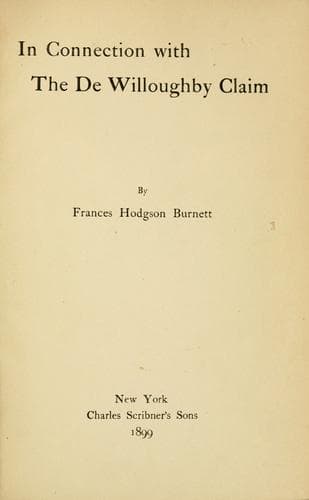
In Connection with the De Willoughby ClaimBurnett, Frances Hodgson
General
In Connection with the De Willoughby Claim
Burnett, Frances Hodgson
United States -- Social life and customs -- 19th century -- Fiction
Both armies having swept through it, Delisleville wore in those days an
aspect differing greatly from its old air of hospitable well-being and
inconsequent good spirits and good cheer. Its broad verandahed houses had
seen hard usage, its pavements were worn and broken, and in many streets
tufted with weeds; its fences were dilapidated, its rich families had
lost their possessions, and those who had not been driven away by their
necessities were gazing aghast at a future to which it seemed impossible
to adjust their ease-loving, slave-attended, luxurious habits of the
past. Houses built of wood, after the Southern fashion, do not well
withstand neglect and ill-fortune. Porticos and pillars and trellis-work
which had been picturesque and imposing when they had been well cared
for, and gleamed white among creepers and trees, lost their charm
drearily when paint peeled off, trees were cut down, and vines were
dragged away and died. Over the whole of the once gay little place there
had fallen an air of discouragement, desolation, and decay. Financial
disaster had crippled the boldest even in centres much more energetic
than small, unbusiness-like Southern towns; the country lay, as it were,
prostrate to recover strength, and all was at a standstill.
Finding himself penniless, Rupert De Willoughby lived in a corner of the
house he had been brought up in. Such furniture as had survived the havoc
of war and the entire dilapidation of old age, he had gathered together
in three or four rooms, which he occupied with the one servant good
fortune brought to his door at a time when the forlornness of his changed
position was continually accentuated by the untidy irregularity of his
life and surroundings. He was only able to afford to engage the shiftless
services of a slatternly negro girl, rendered insubordinate by her newly
acquired freedom, and he had begun to feel that he should never again
find himself encompassed by the decorous system of a well-managed
household.
It was at this juncture that Uncle Matthew arrived and presented his
curious petition, which was that he should be accepted as general
servant, with wages or without them.
He had not belonged to Judge De Willoughby, but to a distant relative,
and, as he was an obstinate and conservative old person, he actually felt
that to be "a free nigger" was rather to drop in the social scale.
Public-domain text, read in full here on John Shaqi.
Reviews
Reviews
No reviews yet
Be the first to share your thoughts on this work.
Elsewhere in the archive
Join the Discussion
Join the discussion
Sign in to leave a comment or review.
Sign InorCreate an account