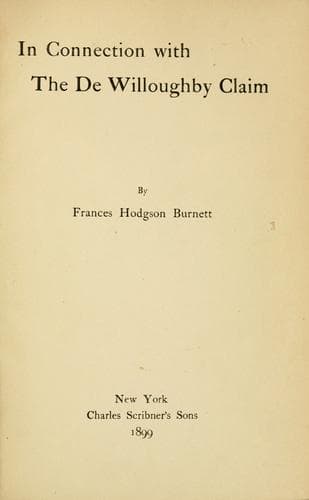
In Connection with the De Willoughby ClaimBurnett, Frances Hodgson
General
In Connection with the De Willoughby Claim
Burnett, Frances Hodgson
United States -- Social life and customs -- 19th century -- Fiction
appealed to by the situation in which he found himself. A negro of his
kind is perfectly capable of building a romance out of much smaller
materials. The amiable vanity which gave such exalted value to all the
belongings of their masters in their days of slavery, and which so
delighted in all picturesqueness of surrounding, is the best of
foundations for romances. From generation to generation certain
circumstances and qualities had conferred a sort of distinction upon
their humbleness; to be owned by an aristocrat, to live in a great house,
to wait upon young masters who were handsome and accomplished and young
mistresses who were beautiful and surrounded by worshippers, to be
indispensable to "de Jedge" or "de Cun'l," or to travel as attendant
because some brilliant young son or lovely young daughter could find no
one who would wait on them as "Uncle Matt" or "Aunt Prissy" could--these
things made life to be desired and filled it with excitement and
importance.
To the halcyon days in which such delights were possible Uncle Matt
belonged. He was too old to look forward; he wanted his past again; and
to find himself the sole faithful retainer in a once brilliant household,
with the chance of making himself indispensable to the one remaining
scion of an old name, assisted him to feel that he was a relic of
departed grandeur.
His contrivances were numberless. In a corner of what he called the "back
gyarden" he constructed an enclosure for chickens. He bought two or three
young fowls, and by marvels of management founded a family with them. The
family once founded, he made exchanges with friendly coloured matrons of
the vicinity, with such results in breeding that "Uncle Matt's" chickens
became celebrated fowls. He displayed the same gifts in the management of
the garden. In a few months after his arrival, Rupert began to find
himself sitting down before the kind of meal he had not expected to
contemplate again.
"Uncle Matt," he said, "where do I get fried chicken and vegetables like
these--and honey and fresh butter and cream? I don't pay for them."
"Yes, you do, sah. Yo' property pays for 'em. Dat 'ar gyarden, sah, is
black with richness--jest black. It's a forchen for a pusson what kin
contrive an' make fren's, an' trade, an' kin flourish a spade. Dar's
fruit-trees an' grape-vines dar--an' room enuf to plant anything--an'
richness enuf to make peas an' taters an' beets an' cabbages jest jump
out o' de yarth. I've took de liberty of makin' a truck patch, an' I've
got me a chicken coop, an' I've had mighty good luck with my aigs an' my
truck--an' I've got things to trade with the women folks for what I
_ain't_ got. De ladies likes tradin', an' dey's mighty neighbourly about
yeah, 'memberin' yo' fambly, sah."
Rupert leaned back in his chair and broke into a hearty, boyish laugh,
which it was very good both to see and hear. He very seldom laughed.
Public-domain text, read in full here on John Shaqi.
Reviews
Reviews
No reviews yet
Be the first to share your thoughts on this work.
Elsewhere in the archive
Join the Discussion
Join the discussion
Sign in to leave a comment or review.
Sign InorCreate an account