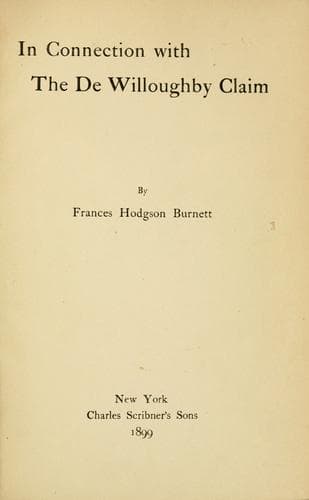
In Connection with the De Willoughby ClaimBurnett, Frances Hodgson
General
In Connection with the De Willoughby Claim
Burnett, Frances Hodgson
United States -- Social life and customs -- 19th century -- Fiction
"Whar's a man stand, sah, if he ain't got no fambly?" he said to Rupert
when he came to offer his services to him. "He stan' nowhar, that's war
he stan'; I've got to own up to it, Marse Rupert, I'se a 'ristycrat bawn
an' bred, an' I 'low to stay one, long's my head's hot. Ef my old mars's
fambly hadn't er gone fo'th en' bin scattered to de fo' win's of de
university, I'd a helt on, but when de las' of 'um went to dat Europe,
dey couldn't 'ford to take me, an' I had ter stay. An' when I heerd as
all yo' kin was gone an' you was gwine to live erlone like dis yere, I
come to ax yer to take me to wait on yer--as a favier, Marse Rupert--as a
_favier_. 'Tain't pay I wants, sah; it's a fambly name an' a fambly
circle."
"It's not much of a circle, Uncle Matt," said Rupert, looking round at
the bareness of the big room he sat in.
"'Tain't much fer you, suh," answered Uncle Matthew, "but it's a pow'fle
deal fer me in dese yere days. Ef yer don't take me, fust thing I knows
I'll be drivin' or waitin' on some Mr. Nobody from New York or Boston,
an' seems like I shouldn't know how to stand it. 'Scuse me a-recommendin'
myself, sah--I _look_ ole, but I ain't as ole as I look; I'se l'arnt to
cook, sah, from three womens what I was married to, an' I knows my place
an' how to keep house like it orter be kep'. Will you try me a mont',
Marse De Willoughby--will you try me a week?"
Rupert tried him and never regretted the venture. In fact, Uncle Matt's
accomplishments were varied for practical reasons. He had been in his
time first house servant, then coachman; he had married at twenty a woman
of forty, who had been a sort of female mulatto Vatel. When she had died,
having overheated herself and caught cold on the occasion of a series of
great dinners given at a triumphant political crisis, he had taken for
his second wife the woman whose ambition it had been to rival her in her
culinary arts. His third marriage had been even more distinguished. His
wife had been owned by some extravagantly rich Creoles in New Orleans,
and had even lived with them during a year spent in France, thereby
gaining unheard-of culinary accomplishments. Matthew had always declared
that he loved her the best of the three. Those matrimonial ventures had
been a liberal education to him. He had learned to cook almost as well as
his first, and from his second and third he had inherited methods and
recipes which were invaluable. He seemed to have learned to do
everything. He dismissed the slatternly negro girl and took upon himself
the duties of both man and woman servant. The house gradually wore a new
aspect--dust disappeared, windows were bright, the scant furniture was
arranged to the best possible advantage, the scant meals were marvels of
perfect cookery and neat serving. Having prepared a repast, Uncle Matt
donned an ancient but respectable coat and stood behind his young
master's chair with dignity. The dramatic nature of his race was strongly
Public-domain text, read in full here on John Shaqi.
Reviews
Reviews
No reviews yet
Be the first to share your thoughts on this work.
Elsewhere in the archive
Join the Discussion
Join the discussion
Sign in to leave a comment or review.
Sign InorCreate an account