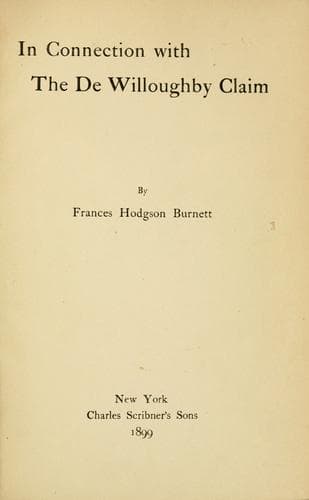
In Connection with the De Willoughby ClaimBurnett, Frances Hodgson
General
In Connection with the De Willoughby Claim
Burnett, Frances Hodgson
United States -- Social life and customs -- 19th century -- Fiction
Sheba strayed in the garden among the flowers. Tom, sitting under the
vines of the porch, watched her white figure straying in and out among
the shrubbery. At last he saw her standing on the grass in the full
radiance of the moonlight, her hands hanging clasped behind her and her
face turned upward to the sky. As she had wandered about, she had done a
fanciful thing. She had made a wreath of white narcissus and laid it on
her hair, and she had twisted together a sort of long garland of the same
blossoms and cast it loosely round her waist.
"She never did that before," Tom said, as he watched her. "Good Lord!
what a picture she is, standing there with her face lifted. I wonder what
she's thinking of."
"Uncle Tom," she said, when she sauntered back to him, "does the
moonlight make you feel sad without being unhappy at all? That is what it
does to me."
"It's the spring, Sheba," he said, as he had said it in the morning;
"it's the spring."
She saw that he was looking at her flower garlands, and she broke into a
shy little laugh.
"You see what you have done to me, Uncle Tom," she said; "now you have
told me I am a beautiful young woman, I shall always be doing things
to--to make myself look prettier."
She came on to the verandah to him, and he held out his hand to her.
"That's the spring, too, Sheba," he said.
She yielded as happily and naturally to the enfolding of his big arm in
these days as she had done when she was a baby. No one but themselves
knew what they were to each other.
They had always talked things over together--their affection, their
pleasures, their simple anxieties and responsibilities. They had
discussed her playthings in the first years of their friendship and her
lessons when she had been a little girl. To-night the subject which began
to occupy them had some seriousness of aspect. The changes time and the
tide of war had made were bringing Tom face to face with a difficulty his
hopeful, easy-going nature had never contemplated with any realising
sense--the want of money, even the moderate amount the requirements of
their simple lives made necessary.
"It's the taxes that a man can't stand up against," Tom said. "You may
cut off all you like, and wear your old clothes, but there's a liveliness
about taxes that takes the sand out of you. Talk about the green bay-tree
flourishing and increasing, all a tax wants is to be let alone a few
years. It'll come to its full growth without any sunning or watering.
Mine have had to be left alone for a while, and--well, here we
are--another year, and----"
"Will the house be taken?" Sheba asked.
"If I can't pay up, it'll all go--house and store and all," Tom answered.
"Then _we_ shall have to go too."
He turned and looked ruefully at the face beneath the wreath of white
narcissus.
"I wish it hadn't come on us just now," he said. "There's no particular
season that trouble adds a charm to; but it seems to me that it's not
entitled to the spring."
Public-domain text, read in full here on John Shaqi.
Reviews
Reviews
No reviews yet
Be the first to share your thoughts on this work.
Elsewhere in the archive
Join the Discussion
Join the discussion
Sign in to leave a comment or review.
Sign InorCreate an account