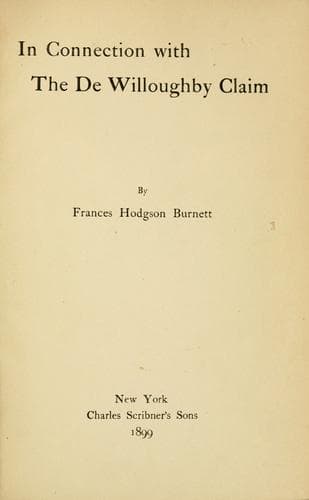
In Connection with the De Willoughby ClaimBurnett, Frances Hodgson
General
In Connection with the De Willoughby Claim
Burnett, Frances Hodgson
United States -- Social life and customs -- 19th century -- Fiction
When she went upstairs she did not go to bed. The moonlight lured her out
into the night again. Outside her window there was a little balcony. It
was only of painted wood, as the rest of the house was, but a multiflora
rose had climbed over it and hung it with a wonderful drapery, and, as
she stood upon it, she unconsciously made herself part of a picture
almost strange in its dramatic quality.
She looked out over the sleeping land to the mountains standing guard.
"Where should we go?" she said. "The world is on the other side."
She was not in the mood to observe sound, or she would have heard the
clear stroke of a horse's hoofs on the road. She did not even hear the
opening of the garden gate. She was lost in the silver beauty of the
night, and a vague dreaming which had fallen upon her. On the other side
of the purple of the mountains was the world. It had always been there
and she had always been here. Presently she found herself sighing aloud,
though she could not have told why.
"Ah!" she said as softly as young Juliet. "Ah, me!"
As she could not have told why she sighed, so there was no explanation of
the fact that, having done so, she looked downward to the garden path, as
if something had drawn her eyes there. It is possible that some
attraction had so drawn them, for she found herself looking into a young,
upturned face--the dark, rather beautiful face of a youth who stood and
looked upward as if he had stopped involuntarily at sight of her.
She drew back with a little start and then bent her Narcissus-crowned
head forward.
"Who--who is it?" she exclaimed.
He started himself at the sound of her voice. She had indeed looked
scarcely a real creature a few moments ago. He took off his hat and
answered:
"I am Rupert De Willoughby," he said. "I beg pardon for disturbing you.
It startled me to see you standing there. I came to see Mr. Thomas De
Willoughby."
It was a singular situation. Perhaps the moonlight had something to do
with it; perhaps the spring. They stood and looked at each other quite
simply, as if they did not know that they were strangers. A young dryad
and faun meeting on a hilltop or in a forest's depths by moonlight might
have looked at each other with just such clear, unstartled eyes, and with
just such pleasure in each other's beauty. For, of a truth, each one was
thinking the same thing, innocently and with a sudden gladness.
As he had come up the garden-path, Rupert had seen a vision and had
stopped unconsciously that instant. And Sheba, looking down, had seen a
vision too--a beautiful face as young as her own, and with eyes that
glowed.
"You don't know what you looked like standing there," said Rupert, as
simply as the young faun might have spoken. "It was as if you were a
spirit. The flowers in your hair looked like great white stars."
"Did they?" she said, and stood and softly gazed at him.
Public-domain text, read in full here on John Shaqi.
Reviews
Reviews
No reviews yet
Be the first to share your thoughts on this work.
Elsewhere in the archive
Join the Discussion
Join the discussion
Sign in to leave a comment or review.
Sign InorCreate an account