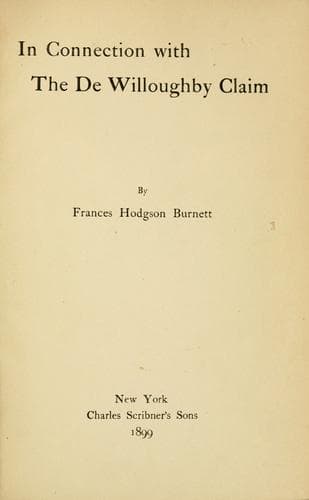
In Connection with the De Willoughby ClaimBurnett, Frances Hodgson
General
In Connection with the De Willoughby Claim
Burnett, Frances Hodgson
United States -- Social life and customs -- 19th century -- Fiction
His middle-aged heart surprised him by giving one quick, soft beat. He
smiled to himself after he had felt it.
"The first moment or so I only stood and looked," Rupert said; "I was
startled."
"And so was I," said Sheba.
"But when she leaned forward and looked down on me," he went on, "I
remembered something----"
"So did I," said Sheba. "I leaned forward like that and looked down at
you from the porch at the tavern--all those years ago, when I was a
little child."
"And I looked up at you--and afterwards I asked about you," said Rupert.
"It all came back when you spoke to-night, and I knew you must be Sheba."
"You knew my name, but I did not know yours," said Sheba. "But, after
all," rather as if consoling herself, "Sheba is not my real name. I have
another one."
"What is it?" asked the young fellow, quite eagerly. His eyes had
scarcely left her face an instant. She was standing by Tom's chair and
her hands were on his shoulders.
"It is Felicia," she said. "Uncle Tom gave it to me--because he wanted me
to be happy." And she curved a slim arm round Tom's neck and kissed him.
It was the simplest, prettiest thing a man could have seen. Her life had
left her nature as pure and translucent as the clearest brook. She had
had no one to compare herself with or to be made ashamed or timid by. She
knew only her own heart and Tom's love, and she smiled as radiantly into
the lighting face before her as she would have smiled at a rose, or at a
young deer she had met in the woods. No one had ever looked at her in
this way before, but being herself a thing which had grown like a flower,
she felt no shyness, and was only glad. Eve might have smiled at Adam so
in their first hours.
Big Tom, sitting between them, saw it all. A man cannot live a score of
years and more, utterly cut off from the life of the world, without
having many a long hour for thought in which he will inevitably find
himself turning over the problems which fill the life he has missed. Tom
De Willoughby had had many of them. He had had no one to talk to whose
mind could have worked with his own. On winter nights, when Sheba had
been asleep, he had found himself gazing into the red embers of his wood
fire and pondering on the existence he might have led if fate had been
good to him.
"There must be happiness on the earth somewhere," he would say.
"Somewhere there ought to have been a woman I belonged to, and who
belonged to me. It ought all to have been as much nature as the rain
falling and the corn ripening in the sun. If we had met when we were
young things--on the very brink of it all--and smiled into each other's
eyes and taken each other's hands, and kissed each other's lips, we might
have ripened together like the corn. What is it that's gone wrong?" All
the warm normal affections of manhood, which might have remained
undeveloped and been cast away, had been lavished on the child Sheba. She
had represented his domestic circle.
Public-domain text, read in full here on John Shaqi.
Reviews
Reviews
No reviews yet
Be the first to share your thoughts on this work.
Elsewhere in the archive
Join the Discussion
Join the discussion
Sign in to leave a comment or review.
Sign InorCreate an account