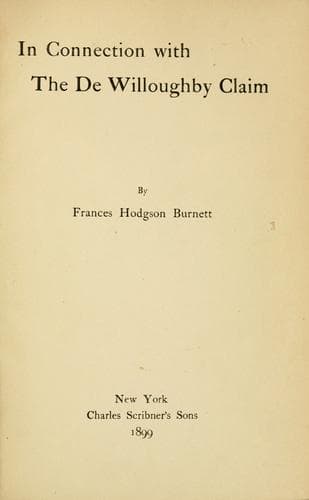
In Connection with the De Willoughby ClaimBurnett, Frances Hodgson
General
In Connection with the De Willoughby Claim
Burnett, Frances Hodgson
United States -- Social life and customs -- 19th century -- Fiction
"You mayn't know it, Sheba," he had said once to her, "but you're a
pretty numerous young person. You're a man's wife and family, and mother
and sisters, and at least half a dozen boys and girls."
All his thoughts had concentrated themselves upon her--all his
psychological problems had held her as their centre, all his ethical
reasonings had applied themselves to her.
"She's got to be happy," he said to himself, "and she's got to be strong
enough to stand up under unhappiness, if--if I should be taken away from
her. When the great thing that's--that's the meaning of it all--and the
reason of it--comes into her life, it ought to come as naturally as
summer does. If her poor child of a mother--Good Lord! Good Lord!"
And here he sat in the moonlight, and Delia Vanuxem's son was looking at
her with ardent, awakened young eyes.
How she listened as Rupert told his story, and how sweetly she was moved
by the pathos of it. Once or twice she made an involuntary movement
forward, as if she was drawn towards him, and uttered a lovely low
exclamation which was a little like the broken coo of a dove. Rupert did
not know that there was pathos in his relation. He made only a simple
picture of things, but as he went on Tom saw all the effect of the hot
little town left ruined and apathetic after the struggle of war, the
desolateness of the big house empty but for its three rooms, its bare
floors echoing to the sound of the lonely pair of feet, the garden grown
into a neglected jungle, the slatternly negro girl in the kitchen singing
wild camp-meeting hymns as she went about her careless work.
"It sounds so lonely," Sheba said, with tender mournfulness.
"That was what it was--lonely," Rupert answered. "It's been a different
place since Matt came, but it has always been lonely. Uncle Tom," putting
his hand on the big knee near him, as impulsively as a child, "I love
that old Matt--I love him!"
"Ah, so do I!" burst forth Sheba. "Don't you, Uncle Tom?" And she put her
hand on the other knee.
Rupert looked down at the hand. It was so fair and soft and full of the
expression of sympathy--such an adorably womanly little hand, that one's
first impulse was to lay one's own upon it. He made a movement and then
remembered, and looked up, and their eyes met and rested on each other
gently.
When the subject of the claim was broached, Sheba thought it like a fairy
tale. She listened almost with bated breath. As Rupert had not realised
that he was pathetic in the relation of the first part of his story, so
he did not know that he was picturesque in this. But his material had
strong colour. The old man on the brink of splendid fortune, the strange,
unforeseen national disaster sweeping all before it and leaving only
poverty and ruin, the untouched wealth of the mines lying beneath the
earth on which battles had been fought--all the possibilities the future
might hold for one penniless boy--these things were full of suggestion
and excitement.
Public-domain text, read in full here on John Shaqi.
Reviews
Reviews
No reviews yet
Be the first to share your thoughts on this work.
Elsewhere in the archive
Join the Discussion
Join the discussion
Sign in to leave a comment or review.
Sign InorCreate an account