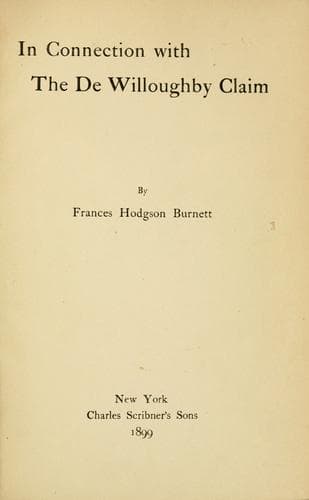
In Connection with the De Willoughby ClaimBurnett, Frances Hodgson
General
In Connection with the De Willoughby Claim
Burnett, Frances Hodgson
United States -- Social life and customs -- 19th century -- Fiction
"I don't know," impetuously; "but I knew I must come to you. It seems a
million years ago since that hot morning in the old garden at
Delisleville--when I had never seen her."
"One of the things I have thought about a good deal," said Tom, with
quite a practical manner, "has been love. I had lots of time to think
over things at the Cross-roads, and I used to work them out as far as my
mind would carry me. Love's as much an element as the rest of them.
There's earth, air, fire, water--and love. It has to be calculated for.
What I've reasoned out is that it has not been calculated for enough.
It's going to _come_ to all of us--and it will either come and stay, and
make the old earth bloom with flowers--or it will come and go, and leave
it like a plain swept by fire. It's not a trivial thing that only boys
and girls play with; it's better--and worse. It ought to be prepared for
and treated well. It's not often treated well. People have got into the
way of expecting trouble and tragedy to come out of it. We are always
hearing of its unhappiness in books. Poets write about it that way."
"I suppose it is often unhappy," said Rupert; "but just now it seems as
if it _could_ not be."
"What _I've_ been wanting to see," said Tom, "is young love come up like
a flower and be given its dew and sun and rain--and bloom and bloom its
best."
He drew a big sigh.
"That poor child who lies on the hillside under the pines," he went on,
"Sheba's mother--hers was young love--and it brought tragedy and death.
Delia," his voice was unsteady, "your mother's was young love, and her
heart was broken. No, it's not often well treated. And when you and Sheba
came to me that night with your boy and girl eyes shining with gladness
just because you had met each other, I said to myself, 'By the Lord, here
is what it springs from. Perhaps it may come to them; I wonder if it
will?'"
"You thought it might, even then," Rupert cried.
"Yes, I did," was Tom's answer. "You were young--you were drawn
together--it seemed natural. I used to watch you, and think it over,
making a kind of picture to myself of how it would be if two young things
could meet each other and join hands and wander on among roses until they
reached the gate of life--and it swung open for them and they passed
through and found another paradise."
He stopped a second and turned to look at Rupert's dreamy face with a
smile not all humorous. "I'm a sentimental chap for my size," he added.
"That's what I wanted for Sheba and you--that's what I want. That sort of
thing was left out of my life; but I should like to see it before I'm
done with. Good God! why can't people be _happy_? I want people to be
_happy_."
The boy was trembling.
"Uncle Tom," he said, "Sheba and I are happy to-night."
"Then God have mercy on the soul of the man who would spoil it for you,"
said Big Tom, with actual solemnity. "I'm not that man. You two just go
on being happy; try and make up for what your two mothers had to bear."
Public-domain text, read in full here on John Shaqi.
Reviews
Reviews
No reviews yet
Be the first to share your thoughts on this work.
Elsewhere in the archive
Join the Discussion
Join the discussion
Sign in to leave a comment or review.
Sign InorCreate an account