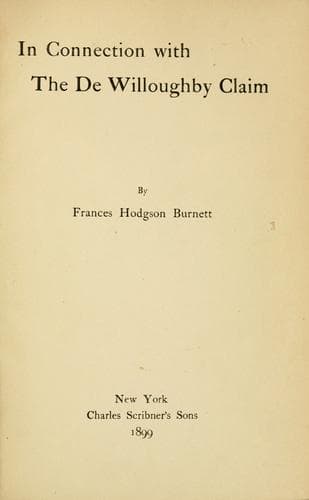
In Connection with the De Willoughby ClaimBurnett, Frances Hodgson
General
In Connection with the De Willoughby Claim
Burnett, Frances Hodgson
United States -- Social life and customs -- 19th century -- Fiction
Rupert got up from his chair and caught the big hand in his. It was a
boy's action, and he looked particularly like a boy as he did it. "It is
just like you," he broke forth. "I did not know what you would say when I
told you--but I ought to have known you would say something like this.
It's--it's as big as you are, Uncle Tom," ingenuously.
That was his good-night. When he went away Big Tom settled into his chair
again and looked out for some time longer at the bright night. He was
going back to two other nights which lay in the years behind. One was the
night he turned his back on Delisleville and rode towards the mountain
with a weight on his kindly heart which he had grimly told himself seemed
to weigh a ton; the other was the night he had been wakened from his
sleep by the knock on the door of the bedroom behind the Cross-roads
Post-office and had ridden out under the whiteness of the moon to find in
the bare cabin at Blair's Hollow the little fair girl who had sobbed and
died as she clung to his warm hand.
CHAPTER XXIX
The world had heard and talked much of the Reverend John Baird in the
years which followed his return to Willowfield. During the first few
months after his reappearance among them, his flock had passed through a
phase of restless uncertainty with regard to him. Certain elder members
of his congregation had privately discussed questions of doctrine with
anxiousness. Had not Nature already arraigned herself upon the man's side
by bestowing upon him a powerful individuality, heads might have been
shaken, and the matter discussed openly instead of in considerately
confidential conclave. It was, however, less easy to enter into argument
with such a man than with one slow and uncertain of tongue, and one whose
fortunes rested in the hands of the questioners. Besides, it was not to
be denied that even the elderly and argumentative found themselves
listening to his discourses. The young and emotional often thrilled and
quaked before them. In his hour he was the pioneer of what to-day we call
the modern, and seemed to speak his message not to a heterogeneous mental
mass, but to each individual man and woman who sat before him with
upturned face. He was daringly human for the time in which he lived, it
being the hour when humanity was overpowered by deity, and to be human
was to be iconoclastic. His was not the doctrine of the future--of future
repentance for the wrongs done to-day, of future reward for the good
to-day achieves, all deeds being balanced on a mercantile account of
profit and loss. His was a cry almost fierce, demanding, in the name of
human woe, that to-day shall hold no cruelty, no evil done, even to the
smallest and most unregarded thing.
Public-domain text, read in full here on John Shaqi.
Reviews
Reviews
No reviews yet
Be the first to share your thoughts on this work.
Elsewhere in the archive
Join the Discussion
Join the discussion
Sign in to leave a comment or review.
Sign InorCreate an account