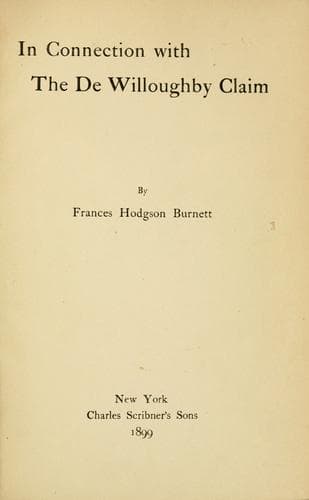
In Connection with the De Willoughby ClaimBurnett, Frances Hodgson
General
In Connection with the De Willoughby Claim
Burnett, Frances Hodgson
United States -- Social life and customs -- 19th century -- Fiction
By some chance--though he alone realised the truth of the fact--the
subjects of his most realistic and intense appeals to his hearers had the
habit of developing themselves in his close talks with Latimer. Among the
friends of the man on whom all things seemed to smile, the man on whom
the sun had never shone, and who faithfully worshipped him, was known as
his Shadow. It was not an unfitting figure of speech. Dark, gloomy, and
inarticulate, he was a strange contrast to the man he loved; but, from
the hour he had stood by Latimer's side, leaning against the rail of the
returning steamer, listening to the monotonously related story of the
man's bereavement, John Baird had felt that Fate herself had knit their
lives together. He had walked the deck alone long hours that night, and
when the light of the moon had broken fitfully through the stormily
drifting clouds, it had struck upon a pallid face.
"Poor fellow!" he had said between his teeth; "poor darkling, tragic
fellow! I must try--try--oh, my God! I must try----"
Then their lives had joined currents at Willowfield, and the friendship
Baird had asked for had built itself on a foundation of stone.
There was nothing requiring explanation in the fact that to the less
fortunate man Baird's every gift of wit and ease was a pleasure and
comfort. His mere physical attractions were a sort of joy. When Latimer
caught sight of his own lank, ill-carried figure and his harshly rugged
sallow face, he never failed to shrink from them and avert his eyes. To
be the companion of a man whose every movement suggested strength and
grace, whose skin was clear and healthful, his features well balanced and
admirable in line--to be the friend of a human being built by nature as
all human beings should be built if justice were done to them, was
nourishment to his own starved needs.
When he assumed his charge at the squalid little town of Janway's Mills,
his flock looked askance at him. He was not harsh of soul, but he was
gloomy and had not the power to convey encouragement or comfort, though
he laboured with strenuous conscientiousness. Among the sordid commonness
of the every-day life of the mill hands and their families he lived and
moved as Savonarola had moved and lived in the midst of the picturesque
wickedness and splendidly coloured fanaticism of Italy in dim, rich
centuries past; but his was the asceticism and stern self-denial of
Savonarola without the uplifting power of passionate eloquence and fire
which, through their tempest, awakened and shook human souls. He had no
gifts of compelling fervor; he could not arouse or warm his hearers; he
never touched them. He preached to them, he visited them at their homes,
he prayed beside their dying and their dead, he gave such aid in their
necessities as the narrowness of his means would allow, but none of them
loved him or did more than stoically accept him and his services.
Public-domain text, read in full here on John Shaqi.
Reviews
Reviews
No reviews yet
Be the first to share your thoughts on this work.
Elsewhere in the archive
Join the Discussion
Join the discussion
Sign in to leave a comment or review.
Sign InorCreate an account