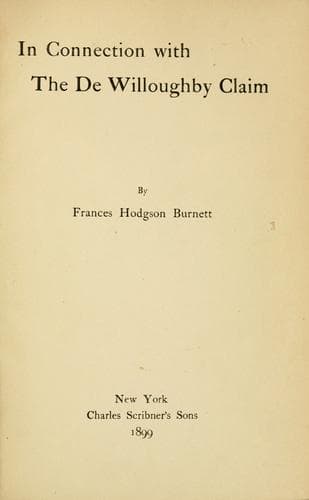
In Connection with the De Willoughby ClaimBurnett, Frances Hodgson
General
In Connection with the De Willoughby Claim
Burnett, Frances Hodgson
United States -- Social life and customs -- 19th century -- Fiction
"The passing of years," he said, "almost inevitably wipes out or dims all
things; but sometimes--not often, thank Fate--there comes a phase of
suffering in some man or woman's life which will not go. I once knew a
woman--she was the kind of woman people envy, and whose life seems
brilliant and full; it was full of the things most people want, but the
things she wanted were not for her, and there was a black wound in her
soul. She had had a child who had come near to healing her, and suddenly
he was torn out of her being by death. She said afterwards that she knew
she had been mad for months after it happened, though no one suspected
her. In the years that followed she dared not allow herself to speak or
think of that time of death. 'I must not let myself--I must not.' She
said this to me, and shuddered, clenching her hands when she spoke.
'Never, never, never, will it be better. If a thousand years had passed
it would always be the same. One thought or word of it drags me back--and
plunges me deep into the old, awful woe. Old--it is not old--it never can
be old. It is as if it had happened yesterday--as if it were happening
to-day.' I know this is not often so. But it is so with me when a thing
drags Margery back to me--drags me back to Margery. To-night, Baird;
think what it is to-night!"
He put a shaking hand on Baird's hand, hurrying him by the unconscious
rapidity of his own pace.
"Think what it is to-night," he repeated. "She seems part of my being. I
cannot free myself. I can see her as she was when she last looked at me,
as her child looked at me to-night--with joyful bright eyes and lips. It
was one day when I went to see her at Boston. She was doing a little
picture, and it had been praised at the studio. She was so happy--so
happy. That was the last time."
"Don't, don't," cried Baird; "you must not call it back."
"I am not calling it back. It comes, it comes! You must let me go on. You
can't stop me. That was the last time. The next time I saw her she had
changed. I scarcely knew how--it was so little. The brightness was
blurred. Then--then comes all the rest. Her growing illness--the
anxiousness--the long days--the girl at the mills--the talk of those
women--the first ghastly, damnable fear--the nights--the lying awake!"
His breath came short and fast. He could not stop himself, it was plain.
His words tumbled over each other as if he were a man telling a story in
delirium.
"I can see her," he said. "I can see her--as I went into her room. I can
see her shaking hands and lips and childish, terrified eyes. I can feel
her convulsive little fingers clutching my feet, and her face--her
face--lying upon them when she fell down."
"I cannot bear it," cried Baird; "I cannot bear it." He had uttered the
same cry once before. He had received the same answer.
"She bore it," said Latimer, fiercely. "That last night--in the cabin on
the hillside--her cries--they were not human--no, they did not sound
human----"
Public-domain text, read in full here on John Shaqi.
Reviews
Reviews
No reviews yet
Be the first to share your thoughts on this work.
Elsewhere in the archive
Join the Discussion
Join the discussion
Sign in to leave a comment or review.
Sign InorCreate an account