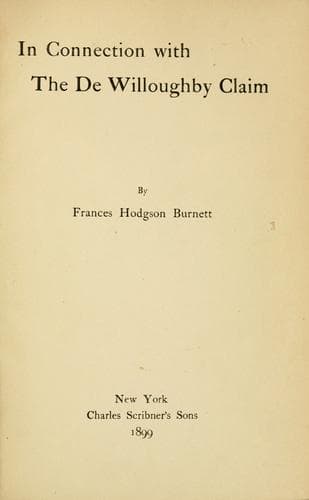
In Connection with the De Willoughby ClaimBurnett, Frances Hodgson
General
In Connection with the De Willoughby Claim
Burnett, Frances Hodgson
United States -- Social life and customs -- 19th century -- Fiction
He was checked. It was Baird's hand which clutched his arm now--it seemed
as if for support. The man was swaying a little, and in the light of a
street-lamp near them he looked up in a ghastly appeal.
"Latimer," he said. "Don't go on; you see I can't bear it. I am not so
strong as I was--before I began this work. I have lost my nerve. You
bring it before me as it is brought before yourself. I am living the
thing. I can't bear it."
Latimer came back from the past. He made an effort to understand and
control himself.
"Yes," he said, quite dull; "that was what the woman I spoke of told
me--that she lived the thing again. It is not sane to let one's self go
back. I beg your pardon, Baird."
CHAPTER XXXIV
"It's a curious job, that De Willoughby claim," was said in a
committee-room of the House, one day. "It's beginning to attract
attention because it has such an innocent air. The sharp ones say that
may be the worst feature of it, because ingenuousness is more dangerous
than anything else if a job is thoroughly rotten. The claimants are the
most straightforward pair the place has ever seen--a big, humourous,
well-mannered country man, and a boy of twenty-three. Rutherford, of
Hamlin County, who is a monument of simplicity in himself, is heart and
soul in the thing--and Farquhar feels convinced by it. Farquhar is one of
the men who are not mixed up with jobs. Milner himself is beginning to
give the matter a glance now and then, though he has not committed
himself; and now the Reverend John Baird, the hero of the platform, is
taking it up."
Baird had proved his incidental offer of aid to have been by no means an
idle one. He had been obliged to absent himself from Washington for a
period, but he had returned when his lecture tour had ended, and had
shown himself able in a new way. He was the kind of man whose
conversation people wish to hear. He chose the right people and talked to
them about the De Willoughby claim. He was interesting and picturesque in
connection with it, and lent the topic attractions. Tom had been shrewdly
right in saying that his talk of it would give it a chance.
He went often to the house near the Circle. Latimer did not go with him,
and had himself explained his reasons to big Tom.
"I have seen her," he said. "It is better that I should not see her
often. She is too much like her mother."
Public-domain text, read in full here on John Shaqi.
Reviews
Reviews
No reviews yet
Be the first to share your thoughts on this work.
Elsewhere in the archive
Join the Discussion
Join the discussion
Sign in to leave a comment or review.
Sign InorCreate an account