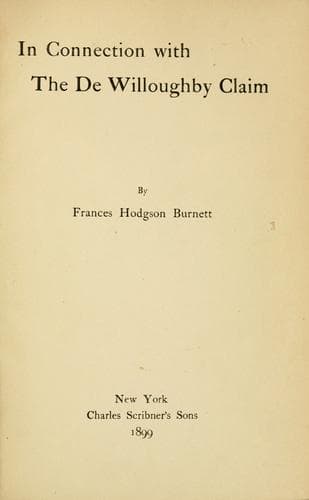
In Connection with the De Willoughby ClaimBurnett, Frances Hodgson
General
In Connection with the De Willoughby Claim
Burnett, Frances Hodgson
United States -- Social life and customs -- 19th century -- Fiction
"He did not know," he said, in a colourless voice. "I told him. He heard
it first from me when I told him how she died."
The handwriting of the letters was Baird's--every character and word and
phrase were his--Baird was the man who had written them.
CHAPTER XXXIX
The street in which the lecture hall stood began to wear the air of being
a centre of interest some time before the doors of the building were
opened. People who had not been able to obtain reserved seats wished to
arrive early. The lectures which had begun by being popular had ended by
being fashionable. At the outset an audience of sober, religious
tendencies had attended them, but after the first one had been delivered
other elements had presented themselves. There had been a sprinkling of
serious scientific men, a prominent politician or so, some society women
whose faces and toilettes were well-known and lavishly described in the
newspapers. On this last night the audience was largely of the
fashionable political world. Carriages drove up one after another and
deposited well-dressed persons who might have been expected that night to
appear at certain brilliant social functions, and who had come to hear
"Repentance" instead.
"He has always had good audiences," said a member of the Committee of
Arrangement, "but he has never had one like this--in Washington at least.
There is the Secretary of State with his wife and daughter. I believe the
President is to be here. He has awakened an enormous interest. The house
will be literally crammed. They are filling the aisle with seats
already."
Baird was in the small retiring-room which had been arranged for his
convenience. His journey had somewhat fatigued him, and he was in the
physical and mental condition to feel glad that this lecture was to be
the last of the series. He was going back to Willowfield, though he was
not to remain there. He had received a call from an important church in
New York and had accepted it. He was endeavouring to make arrangements
that Latimer could be near him. On his return this evening he had found a
letter he had been expecting. It referred to Latimer, and he was anxious
to talk it over with him. He wished he would come in, and felt a little
restless over his delay, though he knew they would have time to say but
few words to each other before it was time for the lecture to begin. He
walked up and down the room looking down at the green carpet and
thinking, his thoughts wandering vaguely to the little pursuant of the
herd claim and the letters he had wanted to deliver. He smiled faintly,
remembering the small frame in the over-large clothes and the bucolic
countenance with its over-sharpness of expression.
The member of the committee looked into the room.
"They are beginning to turn people away from the doors," he said. "Half
the Cabinet is here--I never saw such an audience."
Public-domain text, read in full here on John Shaqi.
Reviews
Reviews
No reviews yet
Be the first to share your thoughts on this work.
Elsewhere in the archive
Join the Discussion
Join the discussion
Sign in to leave a comment or review.
Sign InorCreate an account