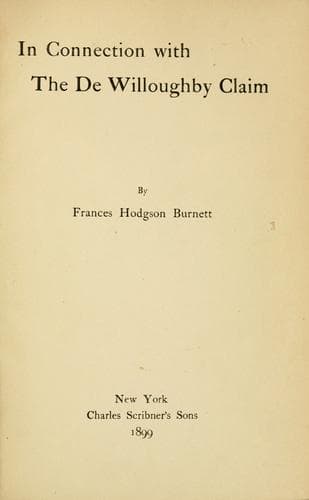
In Connection with the De Willoughby ClaimBurnett, Frances Hodgson
General
In Connection with the De Willoughby Claim
Burnett, Frances Hodgson
United States -- Social life and customs -- 19th century -- Fiction
As he went away smiling, someone passed him in entering the room. Baird,
who was smiling also, changed his expression of courteous appreciation to
a smile of greeting, for the man who had entered was Latimer.
He advanced, holding out his hand.
"I am glad you have come," he began to say. "I wanted at least a word
with you before I went on."
Then his smile died out, leaving blank amazement which a breath's space
later was alarmed questioning. He recalled later how for a second he
stood and stared. Latimer's face was white and damp with sweat. Its lines
were drawn and sunken deep. His eyes were fixed on the man before him
with something which had a ghastly resemblance to an unsteady smile which
was not a smile at all. He looked as if illness--or death--or madness had
struck him. He did not seem a sane man, and yet a stillness so deadly was
expressed by his whole being that it seemed to fill the small, neat,
business-like green-room.
Baird strode towards him and seized him by the shoulder.
"What is it? What is it? What is it?" he cried out.
Latimer's face did not alter in a line. He fumbled stiffly in his
breast-pocket and held out some pieces of yellowed letter-paper--this
being done stiffly, too. He spoke in a hoarse whisper. It seemed to
search every corner of the room and echo there.
"See!" he said. "These are two letters. A man wrote them to a poor,
half-mad child twenty years ago."
The door opened, and the member of the committee looked in again, radiant
with exultation.
"The audience waiting in such breathless silence that you might hear a
pin drop. Two thousand of them, if there's one. Ten minutes to eight."
"Thank you," answered Baird.
The door closed again and he stood looking at Latimer's rigid hand and
the papers.
"They were written to Margery," went on Latimer. "Stamps found them in a
chink in the logs. She had hidden them there that she might take them out
and sob over and kiss them. I used to hear her in the middle of the
night."
Baird snatched them from his hand. He fell into a chair near the table
and dropped his face upon the yellowed fragments, pressing them against
his lips with awful sobbing sounds, as if he would wrest from them the
kisses the long-dead girl had left there.
"I, too!" he cried. "I, too! Oh! my God! Margery!"
"Don't say 'God!'" said Latimer. "When she was dying, in an agony of
fear, she said it. Not that word! Another!"
He said no other--and Latimer drew nearer to him.
"You wrote them," he said. "They are written in your hand--in your
words--I should know them anywhere. You may deny it. I could prove
nothing. I do not want to prove anything. Deny it if you will."
Baird rose unsteadily. The papers were clutched in his hand. His face was
marred by the unnaturalness of a man's tears.
Public-domain text, read in full here on John Shaqi.
Reviews
Reviews
No reviews yet
Be the first to share your thoughts on this work.
Elsewhere in the archive
Join the Discussion
Join the discussion
Sign in to leave a comment or review.
Sign InorCreate an account