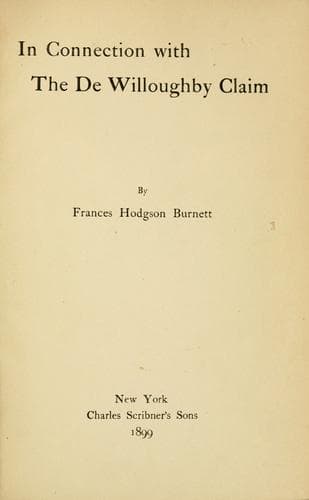
In Connection with the De Willoughby ClaimBurnett, Frances Hodgson
General
In Connection with the De Willoughby Claim
Burnett, Frances Hodgson
United States -- Social life and customs -- 19th century -- Fiction
"Are you going to kill me?" he said. "You know I asked you that once
before."
"No," said Latimer, "I am not going to kill you. I am going to kill the
man who loved you, and found you his reason for living. It's all done
with!"
"No! no!" shrieked Baird, and he hurled himself across the table like a
madman. "No! You are not! No, Latimer! No! God! No!"
They were struggling together--Baird hung to his arm and tried to drag
the pistol from his grasp. But it was no use; Latimer's long, ill-hung
limbs were the stronger. His fixed face did not change, but he wrenched
himself free and flung Baird across the room. He set the pistol against
his heart and pulled the trigger. He gave something like a leap and fell
down.
The door opened for the returning member of the committee and the
impatient applause of the audience came through it almost a roar.
Baird was struggling to rise as if his fall had stunned him. Latimer was
stretched at full length, quite dead.
CHAPTER XL
Tom walked up the staircase pondering deeply. The De Willoughby claim was
before the House. Judge Rutherford was making his great speech, and the
chief claimant might have been expected to be sitting breathless in one
of the galleries. But he was not. He was going to Baird, who had sent for
him, and Baird was sitting in the room in which Latimer lay dead with a
bullet in his heart. He had been sitting there for hours, and when Tom
had arrived at the house he had been told that Baird had asked that he
should be taken to him in the death-chamber. He was sitting on a chair by
the bed on which Latimer was stretched, rigid with a still face, which
looked like a mask of yellow wax, appearing above the exceeding freshness
of the turned-down linen sheet. Baird did not move as Tom entered, but
continued to gaze at the dread thing with dull, drooping eyes. Tom went
to him and laid his hand on his shoulder. He saw the man was stupefied.
"There's nothing to say, Baird," he said after a silence, "when it comes
to this."
"There is something for me to say," Baird answered, very quietly. "I want
to say it before him, while he lies there. I wonder if he will hear?"
"He may."
"It would not do any good to anyone if he did," Baird said. "The
blackness of it all lies in that--that he would not be helped, she would
not be helped--I should not."
"She?" said Tom.
Baird got up at once, stiffly and unsteadily. He stood upright, the
lithe-limbed slender form, which was so much admired upon the platform,
held rigidly. His face looked lined and haggard.
"No other man shall feel an affection for me--I think you are beginning
to feel an affection for me--under a false impression. That man loved me
for long years, and I loved him. I think I helped him to something that
was as near happiness as his nature would allow him to feel. God knows I
owed it to him. I was one of those who repented too late. That is why I
have preached of repentance. I have done it with a secret, frenzied
hope."
Public-domain text, read in full here on John Shaqi.
Reviews
Reviews
No reviews yet
Be the first to share your thoughts on this work.
Elsewhere in the archive
Join the Discussion
Join the discussion
Sign in to leave a comment or review.
Sign InorCreate an account