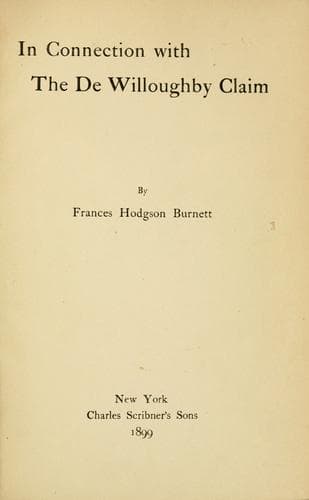
In Connection with the De Willoughby ClaimBurnett, Frances Hodgson
General
In Connection with the De Willoughby Claim
Burnett, Frances Hodgson
United States -- Social life and customs -- 19th century -- Fiction
"Do you think I shall deny it?" he answered. "It is true. I have sat and
listened to your talk of her and thought I should go quite mad. You have
told me of her tortures, and I have listened. I did not know--surely she
did not know herself--of the child--when I went away. It is no use saying
to you--how should it be?--that I loved her--that I was frenzied by my
love of her innocent sweetness!"
"No, there is no use," answered Latimer, in a voice actually void of
emotion, "but I daresay it is true."
"There is no use in calling myself by any of the names invented for the
men who bring about such tragedies. They are true of some men perhaps,
but they were not true of me. I don't know what was true of me. Something
worse than has ever been put into words perhaps, for I loved her and I
have loved her for twenty years. I would have given up my career--my
life, anything she had asked!"
"But when she found you had acted a lie to her----"
"It seemed to fill her with the frantic terror of a child. I dare not
approach her. I think she thought she would be struck dead by Heaven.
Great God! how I understood your story of her prayers. And it was I--it
was I!"
He turned on Latimer with a kind of ferocity.
"You have crucified me!" he cried out. "Let that comfort you. You have
crucified me by her side, that I might see her die--that I might hear her
low little piteous voice--that I might see her throes and terrors. And I
love her--and remember every look of her loving child's eyes--every curve
and quiver of her mouth. Through all the years I have been crucified,
knowing I had earned all that I felt."
Latimer moved across the room, putting the table between them. He went
and stood by the mantel. A murmur of impatient applause from the audience
came through the door.
"You loved her," he said, standing with his hand holding something in his
breast. "And I loved you. She was the one brightness of my life when I
was a boy and you were its one brightness when I was a man. You gave me a
reason for living. I am not the kind of man to be my own reason. I
needn't tell you what you have been to me. You were the one man on earth
I dared to confess to. I knew you would understand and that you knew what
pity was."
Baird groaned aloud. He wiped the sweat from his forehead with his
handkerchief as he listened.
"I knew you were the one man I could trust. I could _trust_ you. I could
confide in you, and talk to you about Margery. One day you said to me
that you had learned to love her and that we might have been brothers."
"When I was left free I had but one thought," Baird said, "to return to
her--to atone, so far as atonement could be--to pray of her upon my
knees. But she was dead--she was dead!"
"Yes, she was dead, and I had no one left to talk to about her. You were
my one comfort and support and friend."
He drew his hand out of his breast. Baird started and then stood quite
quiet. The hand held a pistol.
Public-domain text, read in full here on John Shaqi.
Reviews
Reviews
No reviews yet
Be the first to share your thoughts on this work.
Elsewhere in the archive
Join the Discussion
Join the discussion
Sign in to leave a comment or review.
Sign InorCreate an account