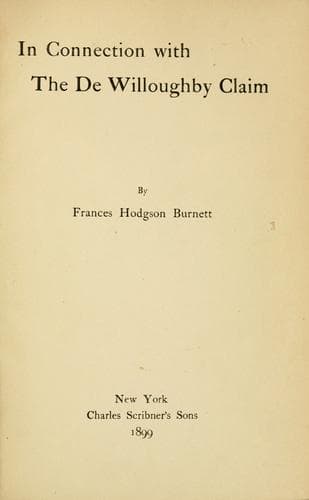
In Connection with the De Willoughby ClaimBurnett, Frances Hodgson
General
In Connection with the De Willoughby Claim
Burnett, Frances Hodgson
United States -- Social life and customs -- 19th century -- Fiction
"I shouldn't want her to know," Tom answered, "but you may come. We shall
go back, and I intend to let those two young ones set up a Garden of Eden
of their own. It will be a good thing to look on at. Yes, you may come."
"That is mercifulness," said Baird, and this time when he put out his
hand he did not withdraw it, and Tom gave it a strong, sober clasp which
expressed more than one emotion.
* * * * *
When Tom returned to the little house near Dupont Circle, Uncle Matt wore
a rigidly repressed air as he opened the door, and Miss Burford stood in
the hall as if waiting for something. Her ringlets were shaken by a light
tremor.
"We have either won the claim this afternoon or lost it," Tom said to
himself, having glanced at both of them and exchanged the usual greeting.
They had won it.
Judge Rutherford was striding up and down the sitting-room, but it was
Sheba who was deputed to tell the news.
She did it in a little scene which reminded him of her childhood. She
drew him to a chair and sat down on his knee, clasping both slim, tender
arms round his neck, tears suddenly rushing into her eyes.
"You and Rupert are rich men, Uncle Tom, darling," she said. "The claim
has passed. You are rich. You need never be troubled about mortgages
again."
He was conscious of a tremendous shock of relief. He folded her in his
arms as if she had been a baby.
"Thank the Lord!" he said. "I didn't know I should be so glad of it."
CHAPTER XLI
The unobtrusive funeral cortege had turned the corner of Bank Street and
disappeared from view almost an hour ago. In the front room of the house
in which had lived the man just carried to his grave, the gentle old
woman who had been his mother sat and looked with pathetic patience at
Miss Amory Starkweather as the rough winds of the New England early
spring rushed up the empty thoroughfare and whirled through the yet
unleafed trees. Miss Amory had remained after the other people had gone
away, and she was listening to the wind, too.
"We are both old women," she had said. "We have both lived long enough to
have passed through afternoons like this more than once before. Howsoever
bad other hours may be, it seems to me that these are always the worst."
"Just after--everything--has been taken away," Mrs. Latimer said now;
"the house seems so empty. Faith," tremulously, "even Faith can't help
you not to feel that everything has gone--such a long, long way off."
She did not wipe away the tear that fell on her cheek. She looked very
small and meek in her deep mourning. She presented to Miss Amory's
imagination the figure of a lovable child grown old without having lost
its child temperament.
Public-domain text, read in full here on John Shaqi.
Reviews
Reviews
No reviews yet
Be the first to share your thoughts on this work.
Elsewhere in the archive
Join the Discussion
Join the discussion
Sign in to leave a comment or review.
Sign InorCreate an account