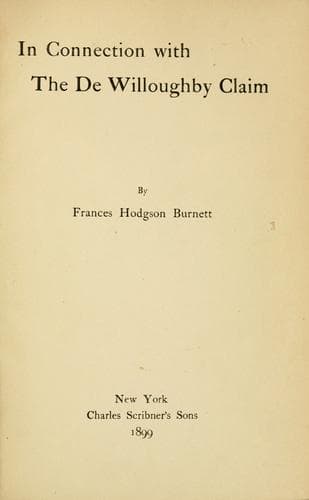
In Connection with the De Willoughby ClaimBurnett, Frances Hodgson
General
In Connection with the De Willoughby Claim
Burnett, Frances Hodgson
United States -- Social life and customs -- 19th century -- Fiction
"But I must not complain," she went on, with an effort to smile at Miss
Amory's ugly old intelligently sympathetic countenance. "It must have
been all over in a second, and he could have felt no pain at all. Death
by accident is always an awful shock to those left behind; but it must
scarcely be like death to--those who go. He was quite well; he had just
bought the pistol and took it out to show to Mr. Baird. Mr. Baird himself
did not understand how it happened."
"It is nearly always so--that no one quite sees how it is done," Miss
Amory answered. "Do not let yourself think of it."
She was sitting quite near to Mrs. Latimer, and she leaned forward and
put her hand over the cold, little, shrivelled one lying on the lap of
the mourning-dress.
"Though it was so sudden," she said, "it was an end not unlike
Margery's--the slipping out of life without realising that the last hour
had come."
"Yes; I have thought that, too."
She looked up at the portrait on the wall--the portrait of the bright
girl-face. Her own face lighted into a smile.
"It is so strange to think that they are together again," she said. "They
will have so much to tell each other."
"Yes," said Miss Amory; "yes."
She got up herself and went and stood before the picture. Mrs. Latimer
rose and came and stood beside her.
"Mr. Baird has been with me every day," she said. "He has been like a son
to me."
A carriage drew up before the house, and, as the occupant got out, both
women turned to look.
Mrs. Latimer turned a shade paler.
"They have got back from the funeral," she said. "It is Mr. Baird."
Then came the ring at the front door, the footsteps in the passage, and
Baird came into the room. He was haggard and looked broken and old, but
his manner was very gentle when he went to the little old woman and took
her hands.
"I think he scarcely knew he had so many friends at Janney's Mills," he
said. "A great many of them came. When I turned away the earth was
covered with flowers."
He drew her to a chair and sat by her. She put her white head on his arm
and cried.
"He was always so sad," she said. "He thought people never cared for him.
But he was good--he was good. I felt sure they must love him a little. It
will be better for him--_now_."
Miss Amory spoke from her place before the fire, where she stood rigidly,
with a baffled look on her face. Her voice was low and hoarse.
"Yes," she said, with eager pitifulness. "It will be better now."
The little mother lifted her wet face, still clinging to Baird's arm as
she looked up at him.
"And I have it to remember," she sobbed, "that you--_you_ were his
friend, and that for years you made him happier than he had ever been. He
said you gave him a reason for living."
Baird was ashen pale. She stooped and softly kissed the back of his hand.
Public-domain text, read in full here on John Shaqi.
Reviews
Reviews
No reviews yet
Be the first to share your thoughts on this work.
Elsewhere in the archive
Join the Discussion
Join the discussion
Sign in to leave a comment or review.
Sign InorCreate an account