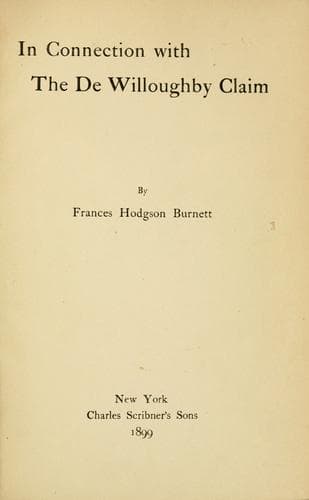
In Connection with the De Willoughby ClaimBurnett, Frances Hodgson
General
In Connection with the De Willoughby Claim
Burnett, Frances Hodgson
United States -- Social life and customs -- 19th century -- Fiction
"Somehow," she said, "you seemed even to comfort him for Margery. He
seemed to bear it better after he knew you. I shall not feel as if they
were quite gone away from me while I can talk to you about them. You will
spare an hour now and then to come and sit with me?" She looked round the
plain, respectable little room with a quiet finality. "I am too old and
tired to live long," she added.
It was Baird who kissed her hand now, with a fervour almost passion. Miss
Amory started at sight of his action, and at the sound of the voice in
which he spoke.
"Talk to me as you would have talked to him," he said. "Think of me as
you would have thought of him. Let me--in God's name, let me do what
there is left me!"
* * * * *
Miss Amory's carriage had waited before the gate, and when she went out
to it Baird went with her.
After he had put her into it he stood a moment on the pavement and looked
at her.
"I want to come with you," he said. "May I?"
"Yes," she answered, and made room for him at her side.
But he took the seat opposite to her and leaned back, shutting his eyes
while Miss Amory's rested upon him. The life and beauty which had been
such ever-present characteristics of his personality seemed to have left
him never to return. Miss Amory's old nerves were strung taut. She had
passed through many phases of feeling with regard to him as the years had
gone by. During those years she had believed that she knew a hidden thing
of him known by no other person. She had felt herself a sort of silent
detective in the form of an astute old New England gentlewoman. She had
abhorred and horribly pitied him. She had the clear judicial mind which
must inevitably see the tragic pitifulness of things. She had thought too
much to be able to indulge in the primitive luxury of unqualified
condemnation. As she watched him to-day during their drive through the
streets, she realised that she beheld a kind of suffering not coming
under the head of any ordinary classification. It was a hopeless, ghastly
thing, a breaking up of life, a tearing loose of all the cords to which a
man might anchor his existence.
When they reached the house and entered the parlour, she went to her
chair and sat down--and waited. She knew she was waiting, and believed
she knew what for. In a vague way she had always felt that an hour like
this would come to them. They were somehow curiously akin. Baird began to
walk to and fro. His lips were trembling. Presently he turned towards the
rigid figure in the chair and stood still.
"It was not an accident," he said. "He killed himself."
"That I felt sure of," Miss Amory answered. "Tell me why he did it."
Baird began to tremble a little himself.
Public-domain text, read in full here on John Shaqi.
Reviews
Reviews
No reviews yet
Be the first to share your thoughts on this work.
Elsewhere in the archive
Join the Discussion
Join the discussion
Sign in to leave a comment or review.
Sign InorCreate an account