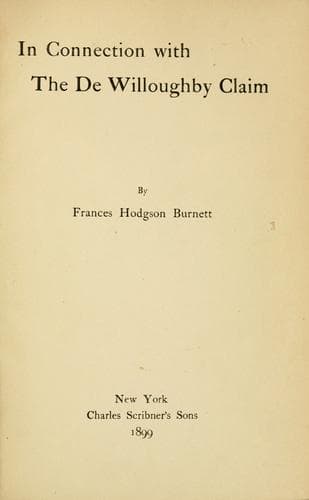
In Connection with the De Willoughby ClaimBurnett, Frances Hodgson
General
In Connection with the De Willoughby Claim
Burnett, Frances Hodgson
United States -- Social life and customs -- 19th century -- Fiction
At length he turned towards those surrounding him and raised his hand,
speaking in a low voice.
"Let us pray."
It was the manner of a man trained to rigid religious observances, and
when the words were uttered, something like an electric shock passed
through his hearers. The circuit-riders who stopped once or twice a month
at the log churches on the roadside were seldom within reach on such an
occasion as this, and at such times it was their custom to depend on any
good soul who was considered to have the gift of prayer. Perhaps some of
them had been wondering who would speak the last words now, as there was
no such person on the spot; but the trained manner and gesture, even
while it startled them by its unexpectedness, set their minds at rest.
They settled themselves in the conventional posture, the women retiring
into their bonnets, the men hanging their heads, and the prayer began.
It was a strange appeal--one which only one man among them could grasp
the meaning of, though all regarded its outpouring words with wonder and
admiration. It was an outcry full of passion, dread, and anguish which
was like despair. It was a prayer for mercy--mercy for those who
suffered, for the innocent who might suffer--for loving hearts too tender
to bear the bitter blows of life.
"The loving hearts, O God!" he cried, "the loving hearts who
wait--who----"
More than one woman looked up from under her bonnet; his body began to
tremble--he staggered and fell into a chair, hiding his face, shaking
from head to foot in an agony of weeping. Tom made his way to him and
bent over him.
"Come with me," he said, his great voice broken. "Come with me into the
air, it will quiet you, and we can wait until--until they come."
He put his arm under his and supported him out of the house.
Two or three women began to rock themselves to and fro and weep aloud
hysterically. It was only the stronger ones who could control themselves.
He was standing at Tom's side then; when they came out a short time
afterwards, walking slowly and carrying the light burden, which they
lowered into its resting-place beneath the pines.
He was quite calm again, and made no sound or movement until all was
over. Then he spoke to Tom.
"Tell them," he said, "that I thank them. I can do no more."
He walked back to the desolate house, and in a little while the people
went their ways, each of them looking back a little wistfully at the
cabin as he or she rode out of sight.
When the last one was lost to view, Tom, who had loitered about, went
into the cabin.
The man was sitting in the empty room, his gaze fixed upon the two chairs
left standing in the middle of it a few paces from each other.
Tom moved them away and then approached him.
"The child has been taken to my house," he said. "You don't want to see
it?"
"No."
"Is there anything else I can do?"
"No, nothing else," monotonously.
"Are you going away?"
"Yes--to-night."
Public-domain text, read in full here on John Shaqi.
Reviews
Reviews
No reviews yet
Be the first to share your thoughts on this work.
Join the Discussion
Join the discussion
Sign in to leave a comment or review.
Sign InorCreate an account