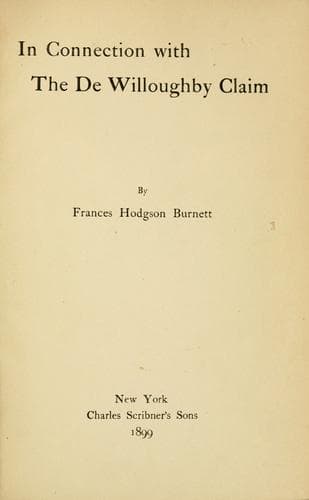
In Connection with the De Willoughby ClaimBurnett, Frances Hodgson
General
In Connection with the De Willoughby Claim
Burnett, Frances Hodgson
United States -- Social life and customs -- 19th century -- Fiction
"She's gwine to be a purty little thing," she said; "she'll be sorter
dark-complected, but she's gwine to hev purty hair 'n' eyes. Ye'll be
right proud of her, Tom, when she's grown, 'n' I guess she'll be a heap
o' company to you. Lord!" with a motherly sigh, "it seems sorter curi's
her bein' left to a man; but you'll do well by her, Tom, you'll do well
by her. I hain't no doubt o' that. You was always mighty clever with
children."
"I'll do all I can for her," said Tom, "though I suppose that isn't
much."
The young woman--she had left her own baby in the store with her
husband--patted the little pillow lightly into shape.
"Ye'll larn a heap by watchin' her," she said. "Jest watch her close 'n'
she'll teach you herself. What do you do about her milk?" anxiously.
"I've been told to do several things," said Tom. "I've been told to boil
it half an hour and not to boil it at all, and to give her all she wanted
and not to give her all she wanted. I'm a little mixed about it."
"Wal, I hain't had but five, but I've allus let it come to a bile an'
then kinder used my reason about givin' it. Seems like the mejumer ye air
with children, the better. But, Lordy! I guess Mornin knows. She raised
her young mistress's."
She kissed the child before she left it, and when she reentered the
store, hurriedly took her own struggling offspring from its father's
arms, settled its pink dress and sunbonnet with a nervous, caressing
motion, and, carrying it to the door, stood with it pressed against her
breast while she seemed to be looking out at the distant mountains. She
did not move until her husband had completed his purchases and came to
her. And when she followed him out to take her place in the waggon, her
eyes were bright and moist.
"Don't ye take the Blair's Holler road, Dave," she said, as he touched up
his horses. "Go round by Jones's."
"What's yer notion, Louizy?" he asked.
"'Tain't nothin' but a notion, I reckon," she answered; "but I don't--I
don't want to hev to pass by that thar grave jest to-day. Take the other
road."
And being an easy-going, kindly fellow, he humoured her and went the
other way.
In the store itself the spirit of hilariousness increased as the day
advanced. By mail-time the porch was crowded and Tom had some slight
difficulty in maintaining order.
"Say, boys," he said, "there's got to be quiet here. If we can't carry on
the establishment without disturbing the head of the household at present
asleep in the back room, this post-office has to close and you can get a
new postmaster. That'd suit you, I daresay. Some fellow, now, that
wouldn't half'tend to his business, not more than half, and that hadn't
legislative ability enough to carry on a precinct, let alone a county.
You want a man of that kind, I suppose. That's what you're working for."
"Tom," said one of the younger ones, "bring her out 'n' let's see her.
You've been braggin' on her all day, but ye hain't let us see her."
Half a dozen others joined in the cry.
Public-domain text, read in full here on John Shaqi.
Reviews
Reviews
No reviews yet
Be the first to share your thoughts on this work.
Join the Discussion
Join the discussion
Sign in to leave a comment or review.
Sign InorCreate an account