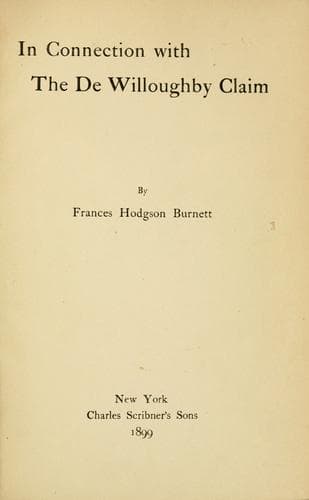
In Connection with the De Willoughby ClaimBurnett, Frances Hodgson
General
In Connection with the De Willoughby Claim
Burnett, Frances Hodgson
United States -- Social life and customs -- 19th century -- Fiction
"Now," she said, "now, Mars Tom, dar ye go right now a-settin' out to
ruinate a good chile, 'stead o' ustin' it ter things--a-settin' out ter
ruinate it. Don't never tip aroun' fer no chile. Don't ye never do it,
'n' ye won't never haf ter. Tippin' roun' jest spiles 'em. Tell ye,
Mornin never tipped roun' when she had em' ter raise. Mornin started out
right from de fust."
Tom looked at the cradle.
"She'll rest easier," he said. "And so shall I. I must get a pair of
slippers." And he slipped out of his shoes and stood ready to spend the
evening in his stocking-feet. A solitary tallow candle stood upon the
table, shedding its yellow light upon all surrounding objects to the best
of its ability, and, seeing that its flickering brightness fell upon the
small sleeper's face, he placed it at the farther end of the high mantel.
"She'll be more comfortable," he said. And then sat down feeling at ease
with his conscience.
Mornin went back to her supper shaking her head.
"By de time she's a year old, dar won't be no managin' her," she said.
"Da's allus de way wid de men folks, allus too hard or too soft; better
leav' her to Mornin 'n' ust'n her to things right at de start."
There seemed little chance that she would be so "ustened." Having
finished his supper, Tom carried his pipe and newspaper into the kitchen.
"I'll sit here awhile," he said. "The smoke might be too much for her,
and the paper rustles so. We'd better let her have her sleep out."
But when the pipe was out and the last page of the paper read, he went
back to his own room. The small ark stranded in his chimney corner was
attractive enough to draw him there. It was a stronger attraction than it
would have been to most men. He had always been fond of children and
curious concerning them. There was not a child in the surrounding region
who had not some remembrance of his rather too lavish good-nature. A
visit to the Cross-roads was often held out as a reward for circumspect
behaviour, and the being denied the treat was considered punishment heavy
enough for most juvenile crimes.
"Ef ye'd had young uns of yer own, Tom, ye'd hev ruined them, shore," the
secretly delighted matrons frequently remarked. "You'd let 'em run right
over ye. I reckon ye keep that candy thar right a-purpose to feed 'em on
now, don't yer?"
His numerous admirers, whose affection for him was founded on their
enjoyment of his ponderous witticisms and the humour which was the little
leavening of their unexciting lives, had once or twice during the past
few days found themselves unprepared for, and so somewhat bewildered by,
the new mood which had now and then revealed itself.
"It's kinder outer Tom's way to take things like he takes this; it looks
onnat'ral," they said.
Public-domain text, read in full here on John Shaqi.
Reviews
Reviews
No reviews yet
Be the first to share your thoughts on this work.
Join the Discussion
Join the discussion
Sign in to leave a comment or review.
Sign InorCreate an account