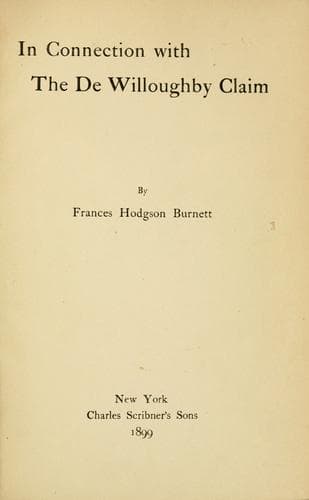
In Connection with the De Willoughby Claim — John Shaqi
In Connection with the De Willoughby ClaimBurnett, Frances Hodgson
General
In Connection with the De Willoughby Claim
Burnett, Frances Hodgson
United States -- Social life and customs -- 19th century -- Fiction
"I think," said his companion, "that it is likely to be the best name you
could give her, for if she isn't a happy creature it won't be your
fault."
"Well," said Tom, "I've set out to do my best and I'd like to give her a
fair start in every way, even in her name, though there mayn't be
anything in it, but I'd like to do it. I suppose it's time I should be
having some object in life. I've never had one before, and I've been a
useless fellow. Well, I've got one now by chance, and I'm bound to hold
on to it and do what I can. I want her to have what chances I can give
her on her side, and it came into my mind that Felicia----"
He stopped to consult the honeysuckle, as it were, and Jenny Rutherford
broke in:
"Yes," she said, "Felicia is the name for her, and it's a beautiful
thought----"
"Oh!" interrupted Tom, bestirring himself uneasily, "it's a natural
thought. She needs all she can get to balance the trouble she began life
with. Most other little chaps begin it in a livelier way--in a way that's
more natural, born into a home, and all that. It's a desolate business
that she should have no one but a clumsy fellow like me to pick her up,
and that there should be a shadow of--of trouble and pain and death over
her from the first. Good Lord!" with a sudden movement of his big arm,
"let's sweep it away if we can."
The thought so stirred him, that he turned quite around as he sat.
"Look here," he said, "that's what I was aiming at when I set my mind on
having her things frilled up and ornamented. I want them to be what they
might have been if she had been born of a woman who was happy and well
cared for and--and loved--as if she had been thought of and looked
forward to and provided for in a--in a tender way--as they say young
mothers do such things: you know how that is; I don't, perhaps, I've only
thought of it sometimes----" his voice suddenly dropping.
But he had thought of it often, in his lonely back room one winter a few
years ago, when it had drifted to him that his brother De Courcy was the
father of a son.
Mrs. Rutherford leaned forward in her seat, tears rose in her eyes, and
she put her hand impulsively on his shoulder.
"Oh!" she cried, "you are a good man. You're a good man, and if she
lives, she will tell you so and love you with all her heart. I will see
to the little clothes just as if they were Nellie's own" (Nellie being
the baby, or more properly speaking, the last baby, as there were others
in the household). "And if there is anything I can ever do for the little
thing, let me do it for her poor young mother's sake."
Tom thanked her gratefully.
"I shall be glad to come to you often enough, I reckon," he said. "I
guess she'll have her little sick spells, as they all do, and it'll help
wonderfully to have someone to call on. There's her teeth now,"
anxiously, "they'll be coming through in a few months, and then there'll
be the deuce to pay."
Public-domain text, read in full here on John Shaqi.
Reviews
Reviews
No reviews yet
Be the first to share your thoughts on this work.
Join the Discussion
Join the discussion
Sign in to leave a comment or review.
Sign InorCreate an account