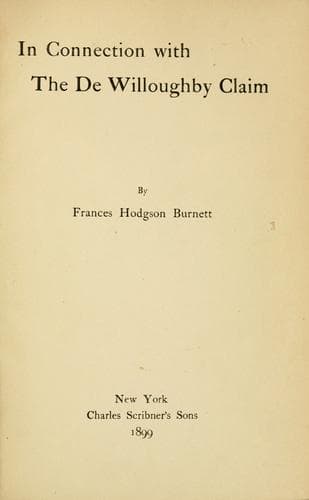
In Connection with the De Willoughby ClaimBurnett, Frances Hodgson
General
In Connection with the De Willoughby Claim
Burnett, Frances Hodgson
United States -- Social life and customs -- 19th century -- Fiction
"I dare say he does feel it very much," said Mrs. Marvin with her
reserved little smile. "He is De Willoughby enough for that."
It was not agreed to that he inherited his father's grace of manner
however. He was a definitely unamiable boy, if one might judge from
appearances. He always wore a dark little scowl, as if he were either on
the point of falling into a secret rage or making his way out of one;
instead of allowing himself to be admired and made a pet of, he showed an
unnatural preference for prowling around the grounds and galleries alone,
sometimes sitting in corners and professing to read, but generally
appearing to be meditating resentfully upon his wrongs in a manner which
in a less handsome boy would have been decidedly unpleasant. Even Mrs.
Marvin's advances did not meet with any show of cordiality, though it was
allowed that he appeared less averse to her society than to that of any
other woman, including the half dozen belles and beauties who would have
enjoyed his boyish admiration greatly.
"I knew your mother," said Mrs. Marvin to him one day as he sat near her
upon the gallery.
"Did you?" he answered, in a rather encouraging way. "When did you know
her?"
"When she was young. We were girls together. She was a beauty and I
wasn't, but we were very fond of each other."
He gave his closed book a sullen look.
"What makes women break so?" he asked. "I don't see why they break so.
She had pretty eyes when she died, but,----"
He drew his handsome black brows down and scowled; and, seeing that he
was angry at himself for having spoken, Mrs. Marvin made another remark.
"You miss her very much?" she said, gravely.
He turned his face away.
"She's better off where she is, I suppose," he said. "That's what they
always say of dead people."
And then still frowning he got up and walked away.
The negro servants about the hotel were all fond of him, though his
manner towards them was that of a fiery and enthusiastic young potentate,
brooking no delay or interference. His beauty and his high-handed way
impressed them as being the belongings of one favoured by fortune and
worthy of admiration and respect.
"He's a D'Willoughby out and out," said his father's negro, Tip. "Ain't
no mistake 'bout dat. He's a young devil when his spirit's up, 'n it's
easy raised. But he's a powerful gen'lman sort o' boy--powerful. Throw's
you a quarter soon's look at ye, 'n he's got the right kind o' high
ways--dough der ain't no sayin' he ain't a young devil; de Kurnel hisself
cayn't outcuss him when his spirit's up."
The Colonel and his son had been at the springs a month, when the
fancy-dress ball took place which was the occasion of a very unpleasant
episode in the annals of this summer.
Public-domain text, read in full here on John Shaqi.
Reviews
Reviews
No reviews yet
Be the first to share your thoughts on this work.
Join the Discussion
Join the discussion
Sign in to leave a comment or review.
Sign InorCreate an account