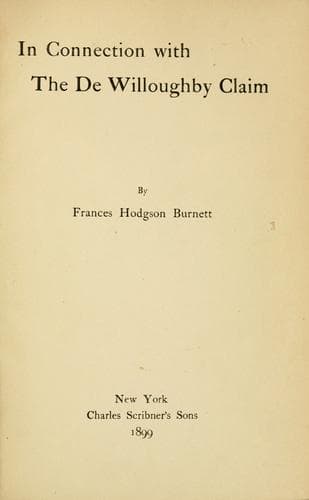
In Connection with the De Willoughby ClaimBurnett, Frances Hodgson
General
In Connection with the De Willoughby Claim
Burnett, Frances Hodgson
United States -- Social life and customs -- 19th century -- Fiction
Before the war there were no people better known or more prominent in
their portion of the State than the De Willoughbys of Delisle County,
Tennessee. To have been born a De Willoughby was, in general opinion, to
have been born with a silver spoon in one's mouth. It was indeed to have
been born to social dignity, fortune, courage, and more than the usual
allowance of good looks. And though the fortune was lavishly spent, the
courage sometimes betrayed into a rather theatrical dare-deviltry, and
the good looks prone to deteriorate in style, there was always the social
position left, and this was a matter of the deepest importance in
Delisleville. The sentiments of Delisleville were purely patrician. It
was the county town, and contained six thousand inhabitants, two hotels,
and a court-house. It had also two or three business streets and half a
dozen churches, all very much at odds with each other and each seriously
inclined to disbelieve in the probable salvation of the rest. The "first
families" (of which there were eight or ten, with numerous branches)
attended the Episcopal Church, the second best the Presbyterian, while
the inferior classes, who could scarcely be counted at all, since they
had not been born in Delisleville, drifted to the Methodists.
The De Willoughbys attended the Episcopal Church, and, being generally
endowed with voices, two or three of them sang in the choir, which was
composed entirely of members of the attending families and executed most
difficult music in a manner which was the cause after each service of
much divided opinion. Opinion was divided because the choir was
divided--separated, in fact, into several small, select cliques, each
engaged in deadly and bitter feud with the rest. When the moon-eyed
soprano arose, with a gentle flutter, and opened her charming mouth in
solo, her friends settled themselves in their pews with a general rustle
of satisfaction, while the friends of the contralto exchanged civilly
significant glances; and on the way home the solo in question was
disposed of in a manner at once thorough and final. The same thing
occurred when the contralto was prominent, or the tenor, or the baritone,
or the basso, each of whom it was confidently asserted by competent
Delisleville judges might have rendered him or herself and Delisleville
immortal upon the lyric stage if social position had not placed the
following of such a profession entirely out of the question. There had
indeed been some slight trouble in one or two of the best families,
occasioned by the musical fervour of youthful scions who were in danger
of being led into indiscretions by their enthusiasm.
Public-domain text, read in full here on John Shaqi.
Reviews
Reviews
No reviews yet
Be the first to share your thoughts on this work.
Join the Discussion
Join the discussion
Sign in to leave a comment or review.
Sign InorCreate an account