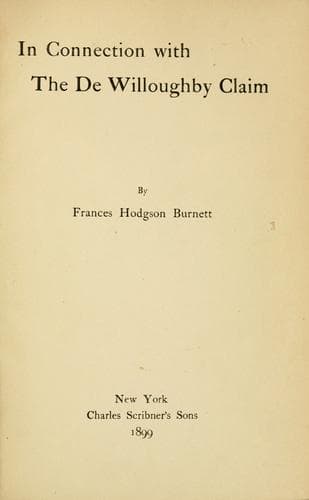
In Connection with the De Willoughby ClaimBurnett, Frances Hodgson
General
In Connection with the De Willoughby Claim
Burnett, Frances Hodgson
United States -- Social life and customs -- 19th century -- Fiction
Latimer bent himself to the child's height and kissed her. The act was
without grace, and when he stood upright he was more awkward and
embarrassed than ever. But the caress was not a cold or rough one, and
when he turned and strode away the flush was still on his sallow cheek.
CHAPTER XIII
The Stornaway parlours were very brilliant that evening in a Willowfield
sense. Not a Burton, a Larkin, or a Downing was missing, even Miss Amory
Starkweather being present. Miss Amory Starkweather was greatly respected
by the Stornaways, the Downings, the Larkins, and the Burtons, the
Starkweathers having landed upon Plymouth Rock so early and with such a
distinguished sense of their own importance as to lead to the impression
in weak minds that they had not only founded that monumental corner-stone
of ancestry, but were personally responsible for the Mayflower. This
gentlewoman represented to the humorous something more of the element of
comedy than she represented to herself. She had been born into a world
too narrow and provincial for the development of the powers born with
her. She had been an ugly girl and an ugly woman, marked by the hopeless
ugliness of a long, ill-proportioned face, small eyes, and a nose too
large and high--that ugliness which even love's eyes can scarcely
ameliorate into good drawing.
The temperament attached to these painful disabilities had been warm and
strongly womanly. Born a century or so earlier, in a French Court, or any
great world vivid with picturesque living, she would in all probability
have been a remarkable personage, her ugliness a sort of distinction; but
she had been born in Willowfield, and had lived its life and been bound by
its limits. She had been comfortably well off--she had a large square
house with a garden, an income sufficient to provide for extremely
respectable existence in Willowfield, but not large enough to allow of
experiments with the outside world. She had never met a man whom she could
have loved, who would have loved her, and she was essentially--though
Willowfield would never have dreamed it--a woman who should have loved and
mated. A lifetime of narrow, unstimulating years and thwarted instincts
had made age treat her ill. She was a thin woman with burning eyes, and a
personality people were afraid of.
Public-domain text, read in full here on John Shaqi.
Reviews
Reviews
No reviews yet
Be the first to share your thoughts on this work.
Elsewhere in the archive
Join the Discussion
Join the discussion
Sign in to leave a comment or review.
Sign InorCreate an account