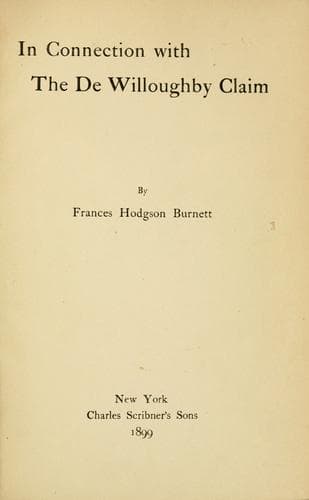
In Connection with the De Willoughby ClaimBurnett, Frances Hodgson
General
In Connection with the De Willoughby Claim
Burnett, Frances Hodgson
United States -- Social life and customs -- 19th century -- Fiction
She had always found an interest in John Baird. When he had come to
Willowfield she had seen in him that element which her whole long life
had lacked. His emotional potentialities had wakened her imagination. If
she had been a young woman she knew that she might have fallen tragically
and hopelessly in love with him; as an old woman she found it well worth
her while to watch him and speculate upon him. When he had become engaged
to Agnes Stornaway, she had watched him and secretly wondered how the
engagement would end; when it had ended in marriage she had not wondered,
but she had seen many things other people did not see. "He is not in love
with her," had been her mental decision, "but he is emotional, and he is
in love with her being in love with him. There is no foretelling what
will come of it."
Baird had found himself attracted by Miss Amory. He did not know that if
she had been young she would, despite her ugliness, have had a powerful
feminine effect on him. He used to go and talk to her, and he was not
conscious that he went when he was made restless by a lack of something
in the mental atmosphere about him. He could talk to her as he could not
talk to the rest of Willowfield. She read and thought and argued with
herself, and as a product of a provincial dogmatic New England town was a
curious development.
"Were you once a brilliant, wicked, feminine mover of things in some old
French court?" he said to her once.
They had been plunging deep into the solving of unsolvable problems, and
she turned her burning old eyes on him as she answered.
"God knows what I was," she said, "but it was nothing like this--nothing
like this--and I was not wicked."
"No," Baird replied, "you were not wicked; but you broke laws."
"Yes, I broke laws," she agreed; "but they were hideous laws--better
broken than kept."
She had been puzzled by the fact that after his wife left him he had had
a restless period and had seemed to pass through a miserable phase, such
as a man suffering from love and longing might endure.
"Has he fallen in love with her because she has gone away?" she wondered;
"men are capable of it at times."
But later she decided mentally that this was not his special case. She
saw, however, that he was passing through some mental crisis which was a
dangerous struggle. He was restless and often away from Willowfield for
two or three days at a time.
"To provide the place with orthodox doctrine once a week is more than he
can bear, and to be bored to extinction into the bargain makes him feel
morbid," she said to herself. "I hope he won't begin to be lured by
things which might produce catastrophe."
Once he came and spent a long, hot summer evening with her, and when he
went away she had arrived at another decision, and it made her wretched.
"He is lured," she thought. "I cannot help him, and God knows Willowfield
could not. After this--perhaps the Deluge."
Public-domain text, read in full here on John Shaqi.
Reviews
Reviews
No reviews yet
Be the first to share your thoughts on this work.
Elsewhere in the archive
Join the Discussion
Join the discussion
Sign in to leave a comment or review.
Sign InorCreate an account