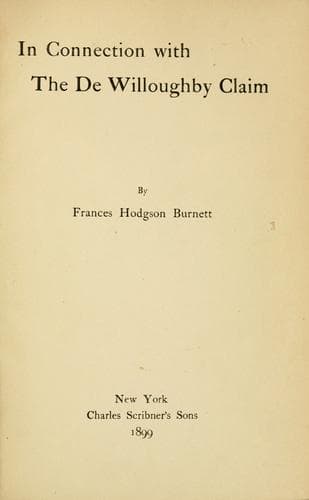
In Connection with the De Willoughby ClaimBurnett, Frances Hodgson
General
In Connection with the De Willoughby Claim
Burnett, Frances Hodgson
United States -- Social life and customs -- 19th century -- Fiction
It was true that he had his eyes open and had more wit and feeling than
they gave him credit for. No one understood him, not even his mother, who
had deplored him from the first hour of his overweighted babyhood, when
she had given him over to the care of his negro nurse in despair.
In the midst of a large family occupied with all the small gaieties
attendant upon popularity and social distinction in a provincial town, he
lived a lonely life, and one not without its pathetic side if it had been
so looked upon. But even he himself had never regarded the matter from a
sentimental point of view. He endeavoured to resign himself to his fate
and meet it philosophically.
"I wasn't cut out for this sort of thing, boys," he had said to his
friends at college, where he had been rather popular. "I wasn't cut out
for it. Go ahead and leave me behind. I'm not a bad sort of fellow, but
there is too much of me in one way and too little in another. What the
Lord made such a man as me for after six thousand years' experience, I
haven't found out yet. A man may as well make up his mind about himself
first as last. I've made up mine and nobody differs from me so far as
I've gone."
When he left college his brothers had already chosen their vocations.
Delisle County knew them as promising young lawyers, each having
distinguished himself with much fiery eloquence in an occasional case.
The cases had not always been gained, but the fervour and poetry of the
appeals to the rather muddled and startled agriculturists who formed the
juries were remembered with admiration and as being worthy of
Delisleville, and were commented upon in the Delisleville _Oriflamme_ as
the "fit echoings of an eloquence long known in our midst as the
birthright of those bearing one of our proudest names, an eloquence
spurred to its eagle flights by the warm, chivalric blood of a noble
race."
But the "warm, chivalric blood" of the race in question seemed to move
but slowly in veins of its most substantial representative. The inertness
of his youngest son roused that fine old Southern gentleman and
well-known legal dignitary, Judge De Willoughby, to occasional outbursts
of the fiery eloquence before referred to which might well have been
productive of remarkable results.
"Good God, sir!" he would trumpet forth, "good God, sir! have we led the
State for generation after generation to be disgraced and degraded and
dragged in the dust by one of our own stock at last? The De Willoughbys
have been gentlemen, sir, distinguished at the bar, in politics, and in
the highest social circles of the South; and here we have a De Willoughby
whose tastes would be no credit to--to his overseer, a De Willoughby who
has apparently neither the ambition nor the qualification to shine in the
sphere in which he was born! Blow your damned brains out, if you have
any; blow your damned brains out, and let's have an end of the whole
disgraceful business."
Public-domain text, read in full here on John Shaqi.
Reviews
Reviews
No reviews yet
Be the first to share your thoughts on this work.
Join the Discussion
Join the discussion
Sign in to leave a comment or review.
Sign InorCreate an account