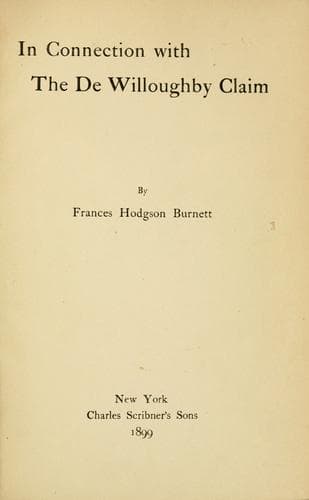
In Connection with the De Willoughby ClaimBurnett, Frances Hodgson
General
In Connection with the De Willoughby Claim
Burnett, Frances Hodgson
United States -- Social life and customs -- 19th century -- Fiction
She saw but little of him for two months, and then he was called across
the Atlantic by his wife's illness and left the place.
"Write to me now and then," he said, when he came to bid her good-bye.
"What can I write about from Willowfield to a man in Paris?" she asked.
"About Willowfield," he answered, holding her hand and laughing a little
gruesomely. "There will be a thrill in it when one is three thousand
miles away. Tell me about the church--about the people--who comes, who
goes--your own points of view will make it all worth while. Will you?"
almost as if a shade anxiously.
She felt the implied flattery just enough to be vaguely pleased by it.
"Yes, I will," she answered.
She kept her word, and the letters were worth reading. It was, as he had
said, her points of view which gave interest to the facts that unexciting
people had died, married, or been born. Her sketch of the trying position
of the unpopular man who filled his pulpit and was unfavourably compared
with him every Sunday morning was full of astute analysis and wit; her
little picture of the gloomy young theological student, Latimer, his
efforts for his sister, and her innocent, pathetic death in a foreign
land had a wonderful realism of touch. She had by pure accident made the
child's acquaintance and had been strongly touched and moved. She did not
write often, but he read her letters many times over.
Upon this evening of his home-coming she thought he had sometimes the
look of a man who felt that he walked in a dream. More than once she saw
him involuntarily pass his hand with a swift movement over his eyes as if
his own touch might waken him. It was true he did not greatly enjoy the
festivities. His occasional views of Mrs. Stornaway as she rambled among
her guests, talking to them about him in audible tones, were trying. She
dispensed him with her hospitalities, as it were, and was diffuse upon
the extent of his travels and the attention paid him, to each member of
the company in turn. He knew when she was speaking of himself and when of
her daughter, and the alternate decorous sentiment and triumphant
pleasure marked on her broad face rasped him to the extent of making him
fear lest he might lose his temper.
"She is a stupid woman," he found himself saying half aloud once; "the
most stupid woman I think I ever met."
Towards the end of the evening, as he entered the room, he found himself
obliged to pass her. She stood near the door, engaged in animated
conversation with Mrs. Downing. She had hit upon a new and absorbing
topic, which had the additional charge of savouring of local gossip.
"Why," he heard her say, "I mean to ask him. He can tell us, I guess. I
haven't a doubt but he heard the whole story. You know he has a way of
drawing people out. He's so much tact and sympathy. I used to tell Agnes
he was all tact and sympathy."
Public-domain text, read in full here on John Shaqi.
Reviews
Reviews
No reviews yet
Be the first to share your thoughts on this work.
Elsewhere in the archive
Join the Discussion
Join the discussion
Sign in to leave a comment or review.
Sign InorCreate an account