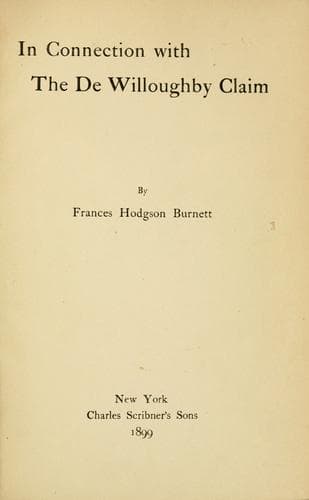
In Connection with the De Willoughby ClaimBurnett, Frances Hodgson
General
In Connection with the De Willoughby Claim
Burnett, Frances Hodgson
United States -- Social life and customs -- 19th century -- Fiction
"All in a glow of gold," he went on a little more hoarsely, "just as it
went down, she turned on her pillow and began to speak to me. She said
'How beautiful it all is, and how glad--,' and her voice died away. I
thought she was looking at the sky again. She had lifted her eyes to it
and was smiling: the smile was on her face when I--bent over her--a few
moments after--and found that all was over."
"It was not like death at all," said his mother with a soft breathlessness.
"She never even knew." And though tears streamed down her cheeks, she
smiled.
Baird rose suddenly and went to Latimer's side. He wore the pale and
bewildered face of a man walking in a dream. He laid his hand on his
shoulder.
"No, it was not like death," he said; "try and remember that."
"I do remember it," was the answer.
"She escaped both death and life," said John Baird, "both death and
life."
The little mother sat wiping her eyes gently.
"It was all so bright to her," she said. "I can scarcely think of it as a
grief that we have lost her--for a little while. Her little room upstairs
never seems empty. I could fancy that she might come in at any moment
smiling as she used to. If she had ever suffered or been sad in it, I
might feel as if the pain and sadness were left there; but when I open
the door it seems as if her pretty smile met me, or the sound of her
voice singing as she used to when she painted."
She rose and went to her son's side again, laying her hand on his arm
with a world of tenderness in her touch.
"Try to think of that, Lucien, dear," she said; "try to think that her
face was never any sadder or older than we see it in her pretty picture
there. She might have lived to be tired of living, and she was saved from
it."
"Try to help him," she said, turning to Baird, "perhaps you can. He has
not learned to bear it yet. They were very near to each other, and
perhaps he is too young to think of it as we do. Grief is always heavier
to young people, I think. Try to help him."
She went out of the room quietly, leaving them together.
When she was gone, John Baird found himself trying, with a helpless
feeling of desperation, to spur himself up to saying something; but
neither words nor thoughts would come. For the moment his mind seemed a
perfect blank, and the silence of the room was terrible.
It was Latimer who spoke first, stiffly, and as if with difficulty.
"I should be more resigned," he said, "I should be resigned. But it has
been a heavy blow."
Baird moistened his dry lips but found no words.
Public-domain text, read in full here on John Shaqi.
Reviews
Reviews
No reviews yet
Be the first to share your thoughts on this work.
Elsewhere in the archive
Join the Discussion
Join the discussion
Sign in to leave a comment or review.
Sign InorCreate an account