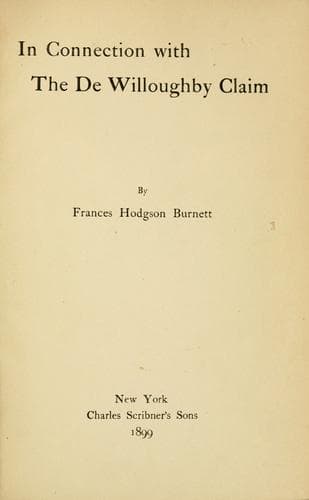
In Connection with the De Willoughby ClaimBurnett, Frances Hodgson
General
In Connection with the De Willoughby Claim
Burnett, Frances Hodgson
United States -- Social life and customs -- 19th century -- Fiction
"She had a bright nature," the lagging voice went on, "a bright
nature--and gifts--which I had not. God gave me no gifts, and it is
natural to me to see that life is dark and that I can only do poorly the
work which falls to me. I was a gloomy, unhappy boy when she was born. I
had learned to know the lack in myself early, and I saw in her what I
longed for. I know the feeling is a sin against God and that His judgment
will fall upon me--but I have no power against it."
"It is a very natural feeling," said Baird, hoarsely. "We cannot resign
ourselves at once under a great sorrow."
"A just God who punishes rebellion demands it of His servants."
"Don't say that!" Baird interrupted, with a shudder; "we need a God of
Mercy, not a God who condemns."
"Need!" the dark face almost livid in its pallor, "_We_ need! It is not
He who was made for our needs, but we for His. For His servants there is
only submission to the anguish chosen for us."
"That is a harsh creed," said Baird, "and a dark one. Try a brighter one,
man!"
"There is no brighter one for me," was the answer. "She had a brighter
one, poor child--and mine was a heavy trouble to her. Why should we
deceive ourselves? What are we in His sight--in the sight of Immutable,
Eternal God? We can only do His will and await the end. We have reason
which we may not use; we can only believe and suffer. There is agony on
every side of us which, if it were His will, He might relieve, but does
not. It is His will, and what is the impotent rebellion of Nature against
that? What help have we against Him?"
His harsh voice had risen until it was almost a cry, the lank locks which
fell over his sallow forehead were damp with sweat. He put them back with
a desperate gesture.
"Such words of themselves are sin," he said, "and it is my curse and
punishment that I should bear in my breast every hour the crime of such
rebellion. What is there left for me? Is there any labour or any pang
borne for others that will wipe out the stain from my soul?"
John Baird looked at him as he had looked before. His usual ready flow of
speech, his rapidity of thought, his knowledge of men and their
necessities seemed all to have deserted him.
"I--" he stammered, "I am not--fit--not fit----"
He had not known what he was going to say when he began, and he did not
know how he intended to end. He heard with a passionate sense of relief
that the door behind them opened, and turned to find that Mrs. Latimer
stood upon the threshold as if in hesitancy.
"Lucien," she said, "it is that poor girl from Janway's Mills. The one
Margery was so sorry for--Susan Chapman. She wants to see you. I think
the poor child wants to ask about Margery."
Latimer made a movement forward, but checked himself.
"Tell her to come in," he said.
Public-domain text, read in full here on John Shaqi.
Reviews
Reviews
No reviews yet
Be the first to share your thoughts on this work.
Elsewhere in the archive
Join the Discussion
Join the discussion
Sign in to leave a comment or review.
Sign InorCreate an account